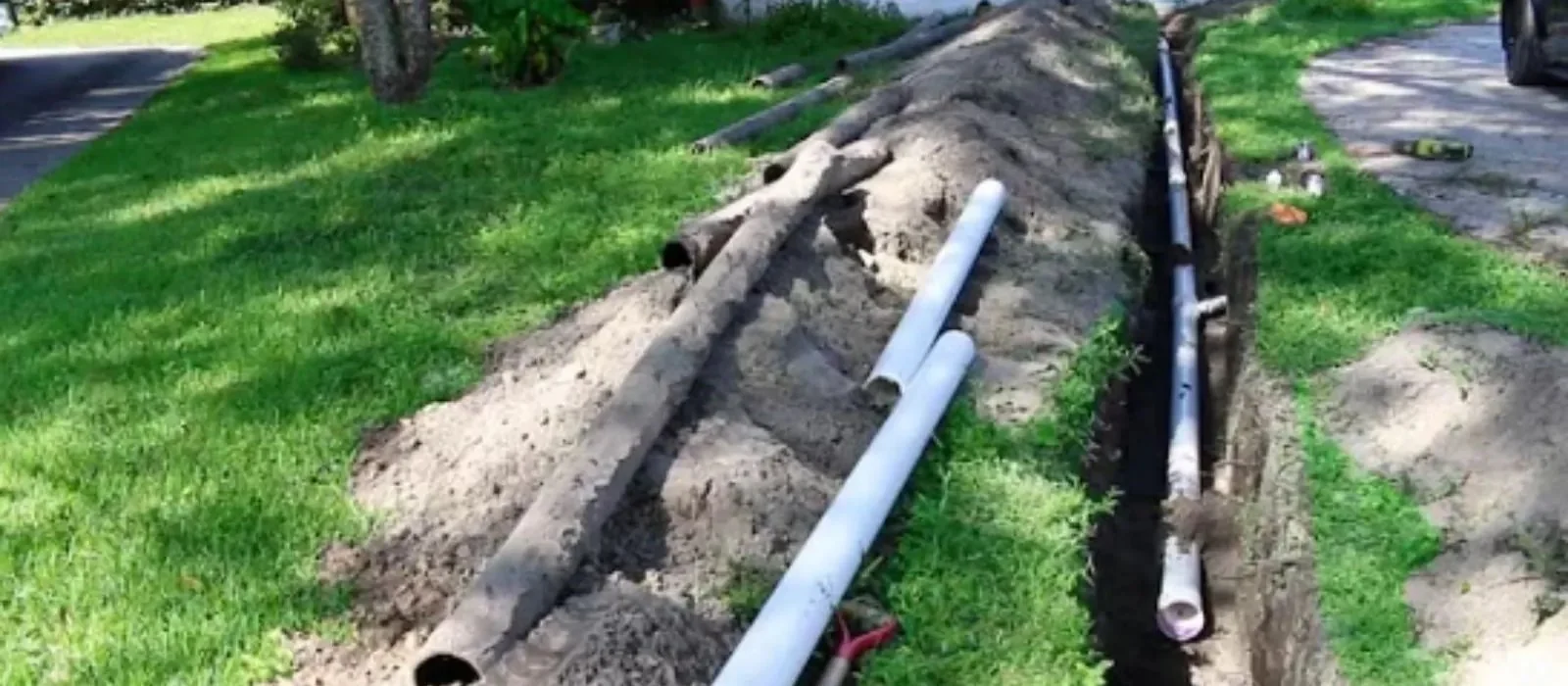
Why older Pennsauken houses may have cast iron drains
The median home in Pennsauken was built in 1964, according to Census survey data, and the oldest housing sits toward the south of the township. Homes of that era often have cast iron for the main drain stack and the building drain, the large pipe that runs under the basement floor or along the wall to the street.
Many houses have had sections swapped for plastic over the years, so one house can hold both. That mix matters because a camera and a look at the visible pipe will tell you more than the age of the house alone.
Signs the cast iron may be failing
Several drains slow together
When the tub, a sink, and a floor drain all slow down at once, the shared drain line is the suspect. Rough scale inside old cast iron catches paper and grease.
Rust, flaking, or damp joints
Visible pipe in the basement may show rust blooms, flaking metal, or stains at the joints. Flaking on the outside can mean the pipe wall is thinner than it should be.
Gurgling and sewer odor
Gurgling sounds, bubbling in a toilet, or a sewer smell near the stack can point to a partial blockage or a leaking joint.
Repeat clogs after cleaning
A line that clogs again soon after each cleaning often has scale or a rough spot that grabs debris.
What scale and graphitization mean in plain terms
Scale is rusty buildup that narrows the inside of the pipe. Over time it also makes the surface rough, so waste hangs up instead of flowing through. A good cleaning can remove loose scale and open the pipe.
Graphitization is different. In this condition the iron in the pipe wall deteriorates into a softer, graphite-like material while the shape stays intact. A pipe in that condition may look sound but crack under a tap, so a plumber should not hammer on it to test it.
| What a camera or inspection shows | Likely direction | Why |
|---|---|---|
| Light scale, pipe round and sound | Cleaning, maybe lining | Lining needs a clean, round host pipe |
| Heavy scale, no cracks, good alignment | Lining often considered | Liner restores a smooth surface |
| Cracks or leaking joints on a straight run | Lining or spot repair | Depends on length and location |
| Sagging, belly, or offset joints | Replacement of that section | A liner follows the shape of the old pipe |
| Collapsed or missing sections | Replacement | Nothing for the liner to hold to |
| Many fittings, tight bends, or hidden stack | Case by case | Fittings and branches limit lining |
Not sure what is in your basement?
Describe the pipes you can see and the symptoms you have, and the dispatcher can explain what a camera inspection would check.
Lining vs replacement: how to choose
Lining tends to fit when
- The pipe is rough or cracked but still round and aligned
- Opening floors and walls would be expensive or disruptive
- The run is long and mostly straight
- A camera shows the full path and branches
Replacement tends to fit when
- The pipe has sagged, collapsed, or separated
- Fittings are corroded or very hard to reach
- You are already opening the walls for a remodel
- The camera cannot pass through the pipe
An EPA white paper on sewer rehabilitation calls lateral reconnection a known weak point of lining. In a house that means every branch, such as a tub or a kitchen line, has to be reopened and sealed well. Ask any contractor how branches and connections are handled.
If a camera shows a damaged or sagging run, a plumber doing sewer line repair can explain whether spot replacement, lining, or a longer replacement is the sounder choice for your layout.
Get a camera look before you decide anything
A camera inspection is the step that turns a guess into a decision. It shows the pipe material, the scale, any cracks, and whether the line holds its slope. Ask for the video and for the plumber to point out the problem spots.
A sewer inspection before a purchase or before a lining quote also gives you a baseline. If one contractor recommends lining and another recommends replacement, the footage lets you compare their reasons.
Questions to ask before agreeing to lining
A short list keeps the quote clear and comparable.
- Did you inspect with a camera, and can I see the footage
- Which parts of the pipe will be lined and which will not
- How will branches, fittings, and connections be reopened
- What happens if the pipe cannot be cleaned enough
- Is a township permit needed, and who pulls it
- What does the work warranty cover, in writing
What affects the price of cast iron lining or replacement
Cast iron work does not have a flat rate because every house is built differently.
After a phone triage and a camera look, the plumber gives you a price before work starts. That includes what is and is not part of the job.
What Pennsauken homeowners should know about permits and housing age
Plumbing permits in Pennsauken are handled by the township Construction Code Department at 2400 Merchantville Ave. Before you agree to a lining or replacement job, ask the contractor whether a permit applies and who will apply for it, and confirm with the department if you want to check.
The township code also routes some approvals through the Camden County Department of Health, the Pennsauken Sewerage Authority, and the water provider. State law says plumbing must be done by a master plumber or an authorized plumbing contractor. Ask for the license number and check it with the NJ Division of Consumer Affairs board before work starts.
The Census median build year of 1964 is a township-wide figure, so it says little about your house. Your own camera footage is the better guide.
Source type: Pennsauken township code and Construction Code Department, NJ Division of Consumer Affairs, U.S. Census ACS data, U.S. EPA public documents
Standards and rules behind this advice
Lining standards such as ASTM F1216 apply to cured-in-place liners, and the EPA has noted that reconnecting lateral lines is a known weak point of lining work.
Cast iron lining questions
No. The pipe has to be cleaned, round, and aligned enough to hold a liner, and the plumber must be able to reach it. Collapsed or badly sagging sections need replacement.
A camera inspection is how you find out which type you have.
Cast iron is heavy, dark gray or rust brown, and makes a dull sound when tapped lightly with a knuckle. Plastic is lighter, white or black, and sounds hollow.
Do not strike old pipe with a tool. If you are unsure, a plumber can identify it with a quick look.
It can, if the smell comes from cracks or leaking joints in the lined section. If the smell comes from a dry trap, a vent problem, or a different part of the system, lining will not fix it.
Find the source first, then choose the repair.
No. It requires cleaning equipment, a camera, resin, curing equipment, and training. A mistake can leave the pipe worse than before, and a failed liner is hard to remove.
You can help by clearing space, noting symptoms, and keeping the footage.
Permits for plumbing work are handled by the Pennsauken Construction Code Department, and the township code has a plumbing permit process. Whether a given job needs one is a question for the department at 2400 Merchantville Ave.
Ask your contractor who will handle it. Neighbors in Collingswood and Cherry Hill deal with their own municipal offices, so rules can differ.