When a hidden leak is an emergency
Most hidden leaks start small, but a few need action right now. Water pouring through a ceiling, a hissing sound inside a wall, or a floor that feels warm underfoot all point to pressurized water escaping.
Treat it as an emergency if water is reaching light fixtures, outlets or the electric panel, or if the loss is fast enough that a bucket fills in minutes. Shut the main valve, stay out of wet areas near electrical equipment, and call the 24/7 line.
Same-day visits are available when the schedule allows, and after-hours calls get the same triage as daytime ones. If the water is coming from a split pipe, burst pipe repair explains the shut-off in more detail.
- Shut the main water valve (usually near the meter or where the line enters the basement).
- Turn off power to a wet area at the breaker only if the panel and your footing are completely dry.
- Move belongings off the floor and photograph the damage before you clean up.
- Do not open walls or lift flooring yourself. Opening the wrong spot often makes the real source harder to trace.
Meter still running or bill jumped? Start here
A water bill that suddenly climbs, with no change in how many people live in the house, is one of the most common first clues to a leak. The meter will confirm it faster than guessing. If the dial moves while every fixture is off, water is going somewhere.
Your meter belongs to the utility, not to you. Most Pennsauken addresses are served by the Merchantville Pennsauken Water Commission, and a few by New Jersey American Water, so check your bill to see which one reads yours. Ask that utility any questions about the meter itself or how a billing period was calculated.
Turn everything off
Close all faucets and stop the dishwasher, washer and ice maker. Make sure nobody flushes during the test.
Find the meter and read it
Lift the cover and note the numbers on the register. Take a photo so you can compare later.
Look at the low-flow indicator
Many meters have a small triangle, star or dial that spins when even a trickle passes through. If it turns with everything off, a leak is likely.
Wait and compare
Check again after an hour or two without using water. A changed reading confirms the leak, and a shut main valve that stops the movement points to the house side of the line.
Meter moving with everything off?
Tell the dispatcher what the meter shows. We will tell you whether the leak is likely inside the house, in the yard or at the street.
How we locate a leak without opening the wall
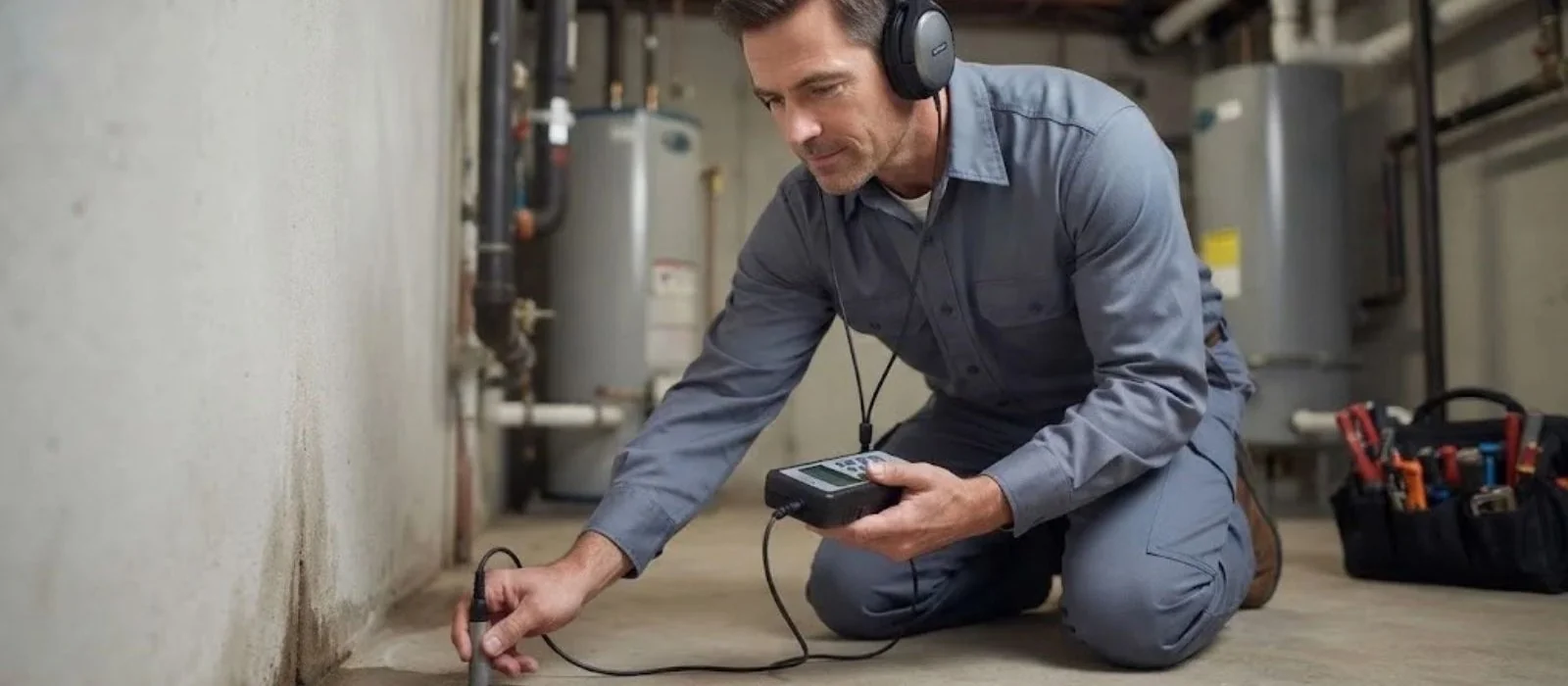
No single tool finds every leak. A plumber usually combines several methods, starting with the least invasive and narrowing down until the spot is confirmed.
The table shows what each method is good at, and where it falls short.
| Method | What it finds | Limit |
|---|---|---|
| Acoustic listening | The sound of water escaping from a pressurized pipe, through floors, walls or soil | Quiet leaks and noisy surroundings can mask the signal |
| Thermal imaging | Temperature differences from hot water lines or wet materials behind a surface | Shows a pattern, not always the exact joint |
| Moisture meters | Dampness in drywall, wood and masonry, mapped across a wall or ceiling | Cannot tell a supply leak from condensation by itself |
| Pressure testing | Whether a closed section of pipe holds pressure, which isolates the failing run | Confirms a leak exists, then other tools place it |
| Tracer gas | A harmless gas pushed into a drained line that escapes at the hole and is sniffed out | Needs a line that can be isolated and filled |
| Pipe locators | The path and depth of buried metal or plastic lines so digging starts in the right place | Only maps the route, it does not detect water by itself |
Slab leak: signs that water is escaping under the floor
A slab leak is a break in a water line that runs in or beneath a concrete slab floor. Many Pennsauken homes have basements or crawlspaces with piping hung in the open, so slab-on-grade leaks mostly affect slab foundations, additions and some newer construction. If your house sits on a slab, the signs below deserve a prompt call.
A warm spot on the floor
A hot water line leaking under a slab can warm the surface above it. Bare feet notice it before anything else does.
Hissing or running water sound
Listen in a quiet room at night with the fixtures off. A steady trickle or hiss under the floor suggests a pressurized line.
Pressure that drops
Weak flow at several fixtures, with no clog and no change at the street, can mean water is leaving the system before it reaches you.
Damp carpet, lifting tile or musty smell
Moisture that returns after drying, especially along one line of the room, often traces back to a slab line.
Once the area is mapped, the usual options are repairing the line in place, rerouting it through walls or the attic, or replacing the run. Rerouting often costs less disruption than breaking concrete, and we explain both before work starts.
Stain on a ceiling or wall, but no obvious source
Water travels along framing and pipes before it shows itself, so the stain is rarely under the leak. A brown ring on a ceiling can come from a bathroom above, a roof problem, a heating line or a drain joint.
A moisture map and thermal scan usually narrow the source to one wall cavity. Tell us when the stain appeared and whether it grows after showers, rain or heating cycles, because that timing separates a plumbing leak from a roof or condensation problem.
Basement and crawlspace leaks
Pennsauken's median house was built in 1964, and homes of that era often have supply lines, drain stacks and shut-off valves exposed under the first floor. That helps, because a leak there can often be seen, heard and traced without breaking anything open.
We check joints, valves, the water heater connections and the meter setup first. Look for drips on pipe bottoms, green or white crust on copper, rust bloom on older galvanized steel, and damp insulation. Water on a basement floor can also come from outside or from a sump problem, so we sort supply leaks from drainage issues before recommending a fix.
Buried line leaks between the street and the house
The service line runs underground from the utility's connection to your meter or foundation. A leak there can run for months without surfacing, which shows up as a rising bill, a soft or green patch of lawn, or pressure that sags.
We confirm the leak with a pressure check and listening, then use a pipe locator to trace the path so digging is limited to one spot. Ask MPWC where their responsibility ends and yours begins at your address. The details of repairing or replacing the line are on our water line repair page.
Stain, damp spot or warm floor?
Describe where it is and when it started. We will plan the least destructive way to find the source.
Pennsauken water: who to call and what to check
Most Pennsauken addresses are on the Merchantville Pennsauken Water Commission, whose office is at 6751 Westfield Ave and whose water emergencies line is (856) 663-0044. Their staff can tell you about the meter, usage history and anything on the street side.
If the problem is on your side of the connection, you call us. If a main on the street is leaking or a meter is damaged, the utility handles it. A quick call to sort out which side the leak is on avoids paying a plumber to dig up something the utility owns.
Source type: Merchantville Pennsauken Water Commission public pages
Smaller cases: sprinklers, pools and the meter box
Irrigation leaks hide because the zones run on a timer. A damp patch, a lawn that stays soggy after the cycle ends, or a pressure drop when the system starts all suggest a cracked riser or fitting. Isolating each zone with the valves usually shows which one is losing water.
Pool and spa leaks are harder to judge, since evaporation also drops the level. A bucket test and a pressure check of the plumbing lines tell the two apart. Water pooling around the meter box in the yard is a different case: the box and meter belong to the utility, so report that one to MPWC first.
What affects the price of leak detection
Leak detection is priced on what it takes to find the leak, not on a flat menu. Two houses with the same symptom can need very different work.
Call the 24/7 line and we do phone triage first. After a technician sees the problem, you get a clear price before any work starts, and you decide whether to go ahead.
Have this ready when you call
A few details speed up the diagnosis and help us bring the right tools.
- Which fixtures are affected and where the wet area is.
- Whether the meter moves with everything off, and a photo of the reading.
- When the bill rose, or when the stain first appeared.
- Whether the home is on a basement, crawlspace or slab.
- The location of your main shut-off valve and whether it closes fully.
Leaks in commercial buildings
Shops, offices and multi-unit buildings have longer pipe runs, shared risers and tenant questions, so the process differs from a house call. We cover that kind of work separately on our commercial plumbing page, and a quick phone call tells us whether we are the right fit for your building. We also take leak calls in nearby Collingswood, where the water comes from a borough system rather than MPWC.
After the leak is found
Locating the leak is only half the job. For a burst section, see our burst pipe repair guidance. For a pipe network that keeps failing in new places, repiping may make more sense than another patch, which we explain on the repiping page.
Plumbing permits in Pennsauken are handled by the township Construction Code Department, and we tell you up front if your repair needs one.
Standards and rules behind this advice
The EPA WaterSense program publishes a simple meter-based leak check: read the meter, avoid using any water for a set period, then read it again. Fixture leaks such as toilet flappers are also covered in its guidelines. Merchantville Pennsauken Water Commission customers can ask the Commission about their meter.
Leak detection questions from Pennsauken homeowners
Yes, a hidden leak does not keep office hours and neither does our phone. Call at 2 a.m. or on a Sunday and a dispatcher asks what the meter and the wet area look like, then tells you what to shut off. Same-day scheduling depends on availability, and no arrival time is promised.
Turn off every fixture, appliance and ice maker, then look at the meter. A spinning low-flow indicator or a register that changes after an hour means water is moving somewhere. If it stops when you close the main valve, the leak is on the house side. Ask your utility about the meter itself.
Often yes. Acoustic listening, thermal imaging and moisture mapping narrow the source before anything is opened. Sometimes a small inspection hole is still needed to confirm and repair the pipe. We aim for the smallest opening that lets us do the job correctly.
Less often. Many Pennsauken homes have basements or crawlspaces where lines are exposed, so slab leaks mostly affect slab foundations, additions and some newer builds. If a line is buried in concrete, the warm-floor and hissing signs apply.
It depends on where the utility's responsibility ends. The meter and curb stop belong to the utility. Ask MPWC, or your utility if you are on New Jersey American Water, where the line becomes yours at your address. Our water line repair page covers what happens when the fault is on your side.
Policies vary a lot, so ask your insurer before work begins. Photograph the damage, keep the written findings from the technician, and save any moisture or pressure test results. That paperwork helps whichever way the claim goes.
We can look at irrigation zones and pool or spa plumbing lines, mostly through pressure checks and isolation. Water loss from a pool also includes evaporation, so a simple bucket test comes first. Leaks in a utility meter box are reported to the utility.