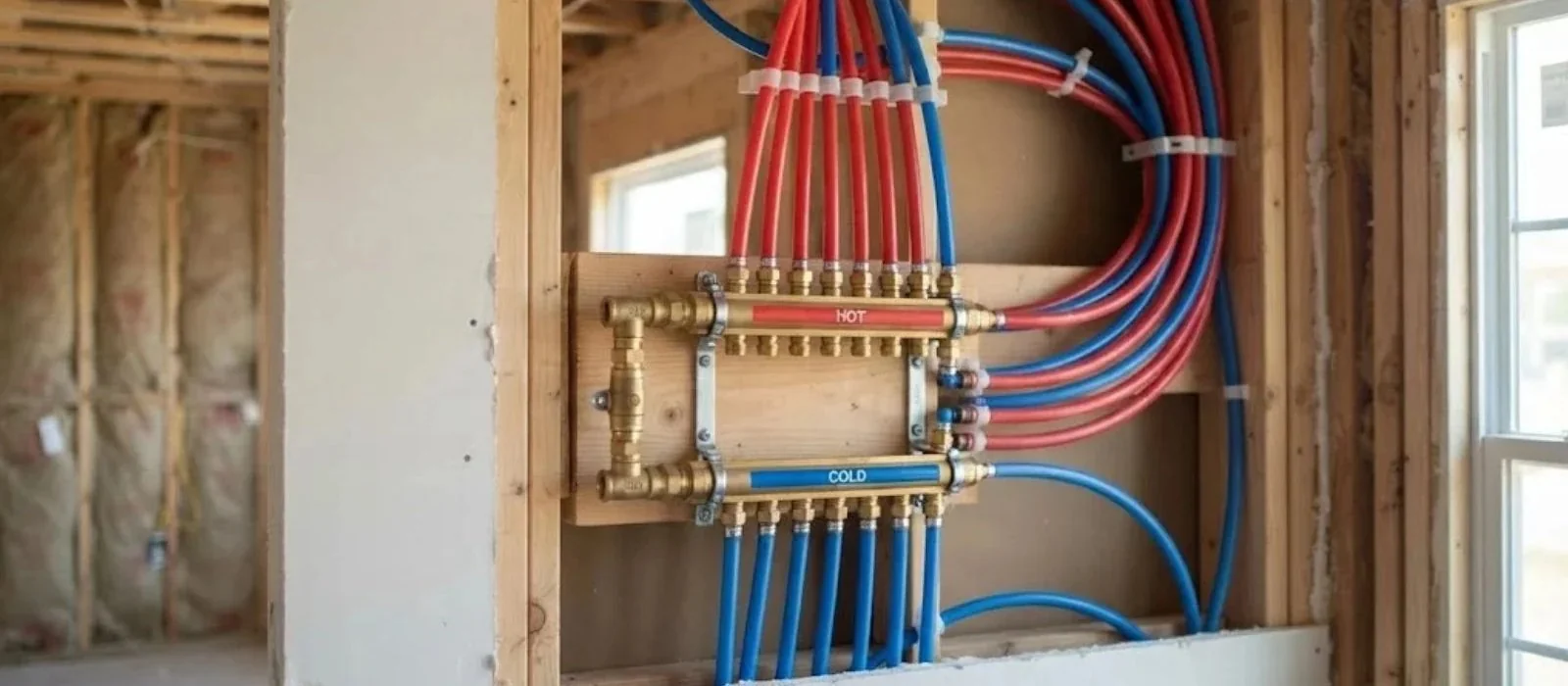
Signs your pipes may be due for replacement
Brown or yellow water
Rusty water that clears slowly after running often means steel pipe is shedding scale inside. A water heater problem can look similar, so we check both.
Pressure that fades over time
Interior buildup narrows older steel pipe, so flow weakens at fixtures far from the main. Showers upstairs usually suffer first.
Pinhole leaks in more than one place
A single leak is a repair. A second and third pinhole in the same system, often in different rooms, suggest the whole run is thin.
Stains or damp spots near pipes
Green crust on copper, rust trails on steel and soft drywall around a pipe all point to slow leaks.
Water tests or a lead line concern
If testing or the utility's records raise a flag about lead, replacing the suspect pipe belongs on the planning list.
None of these alone proves you need a repipe. A plumber should inspect the pipe, test pressure, and check how the system is behaving before suggesting it.
What a 1964 house usually has behind the walls
Pennsauken's median home was built in 1964, with older homes concentrated in the south and newer construction toward the northeast. Homes of that era often have copper supply lines, and some earlier ones still carry galvanized steel. Repairs and remodels over the decades also mean a single house may hold two or three different pipe materials.
That mix is why we inspect before quoting. A house with a recent copper addition and galvanized behind the original kitchen needs a different plan from one that is galvanized throughout. We do not state how long a given pipe should last, since water conditions and installation quality change the answer.
| Era of the home | Often found | Common concern | Typical direction |
|---|---|---|---|
| Older homes, mid-century and before | Galvanized steel supply, cast iron drain, possible lead service pipe | Rust, low flow, lead questions | Replace steel and ask the utility about the service line |
| Mid-1960s to 1980s | Copper supply with soldered joints, mixed with older sections | Pinholes and joint failures in some systems | Spot repair or targeted replacement, repipe if failures repeat |
| Later and newer homes | Copper or PEX | Fittings, appliance connections | Usually repairs, not repiping |
Not sure what is inside your walls?
Describe the house and what you are noticing. We will tell you what to look for and whether an inspection makes sense.
PEX or copper: an honest comparison
Both are accepted choices for home supply plumbing, and neither is right for every house. The decision comes down to access, budget, water conditions and what you prefer to live with.
| Factor | PEX | Copper |
|---|---|---|
| Installation | Flexible tubing that bends around corners, often needs fewer wall openings | Rigid pipe with soldered or press joints, more cutting and fitting |
| Behavior with water | Does not corrode the same way and resists some mineral buildup | Can pit or corrode in some water conditions, handles heat well |
| Exposure | Should not sit in direct sunlight and needs protection where exposed | Fine in exposed locations, such as a basement ceiling |
| Repairs later | Needs matching fittings and tools | Traditional skills, easy to splice |
| Fit for your house | Often chosen when walls are costly to open | Often chosen where the system is exposed and an owner wants metal |
Walls, access and how much gets opened
The cost and mess of repiping come mostly from reaching the pipe, not from the pipe itself. In a house with an open basement, most of the supply plumbing runs along joists and can be replaced with little demolition. Risers inside walls to upstairs bathrooms and kitchens are the hard part.
Small access holes, often placed in closets or behind fixtures, let a plumber fish new pipe through existing cavities. Patching the holes is separate work, and we tell you up front what is included and what you will want a drywall or paint contractor to handle.
Whole-house repipe or phased replacement?
A phased approach suits you if
- Only part of the house has bad pipe, such as one bathroom group.
- You want to spread out the cost or the disruption.
- Other work, like a kitchen remodel, is coming and can share the wall openings.
- The failures are few and clearly isolated.
A whole-house repipe fits when
- Most of the system is the same aging material.
- Leaks keep appearing in new places.
- Pressure and water color are poor throughout.
- You would rather open the walls once and be done.
Living in the house during the work
A repipe usually does not require you to move out, but expect interruptions. The water is shut off for stretches of each work day, and we plan those periods with you so you can cook, shower and use the bathroom beforehand or afterward.
Dust and noise are real, especially when walls are opened. We cover floors, ask you to clear the work areas, and keep pets and children away. Tell us about home offices, medical needs or anyone who needs water at specific times, so we can plan around them.
Clear access
Move furniture, storage and wall hangings away from the areas that will be opened. Closets near bathrooms are often access points.
Plan for water outages
Store drinking water, and arrange for showers and laundry on days when the system is off.
Protect valuables
Remove breakables, electronics and anything fragile from nearby shelves, since cutting and drilling shake walls.
Permits and the water utility in Pennsauken
Permits for this kind of work come from the Construction Code Department at 2400 Merchantville Ave. We confirm what your project needs with them, so you do not guess. A permit means inspections, which protect you if you sell later.
Most addresses are on the Merchantville Pennsauken Water Commission, and a few are on New Jersey American Water. If your main service line is old, or lead is a concern, ask your utility about the line from the street. A repipe inside the house does not replace it, and the two jobs are best planned together.
Source type: Township of Pennsauken and Merchantville Pennsauken Water Commission public pages
Lead-suspect lines and what to do about them
Older homes may have lead in the service line, in solder, or in old fittings, and a visual check is the first step. A magnet and a scratch test can hint at the pipe's material, but they are not proof. Lab testing and the utility's records are the reliable sources.
If your house has suspect pipe, say so on the first call. Replacing it is part of the plan, and the utility's Lead Service Line resources at mpwc.com can help you learn what is known at your address. Our water line repair page covers the street-to-house section.
What affects the price of a repipe
Every house is different, so a repipe is priced after someone has seen the pipes and the walls.
We start with a phone conversation, then a licensed plumber inspects the house. You receive a clear, written price before work starts, and you decide whether to proceed.
Ready to compare options for your house?
Tell us the age and layout. We will help you decide between a spot repair, a phased plan or a full repipe.
If you are chasing a single stubborn leak first, start with leak detection. For a burst that has already happened, see burst pipe repair. If the pipe damage includes the fixtures themselves, our faucet and sink repair page covers the fixtures themselves.
Standards and rules behind this advice
Copper tube in plumbing is made to ASTM B88 and PEX tubing to ASTM F876, and both are used with fittings certified to NSF/ANSI 61 for drinking water. Plumbing work in New Jersey falls under the state Uniform Construction Code, which the Pennsauken Construction Code Department enforces locally, and repiping normally needs a permit.
Repiping questions before you commit
One leak in sound pipe is usually a repair. Repeated pinholes, brown water that returns, and pressure that has dropped across the house point toward replacement. A plumber should inspect the pipe and test pressure before recommending it, and explain the reasoning in plain terms.
Neither is better in every case. PEX is flexible and often needs fewer wall openings, while copper is rigid, handles exposure well and is familiar to repair. The right pick depends on your house, your water and your priorities, so we explain both before you choose.
Usually some access is needed, but the amount varies. Open basements and attics keep it small. Small holes in closets or behind fixtures are common, and patching is separate work. We describe the access plan before work begins.
In most cases yes. Water is off for part of each work day, so plan meals, showers and laundry around that. We coordinate the schedule with you. If anyone has a medical need for constant water, tell us at the start.
Permits for plumbing work are handled by the township Construction Code Department. Ask them about your project, or let us confirm the requirements. Inspections are part of the process, and they protect you as the owner.
If most of your system is the same aging pipe, a whole-house repipe saves repeated disruption. If only a section is bad, or you want to spread the work out, phasing can make sense. We lay out both options so you can compare.
It can, if the cause is narrowed galvanized or corroded pipe. Pressure problems also come from a regulator, a partly closed valve or the service line from the street. We test first, so you do not pay for the wrong fix.