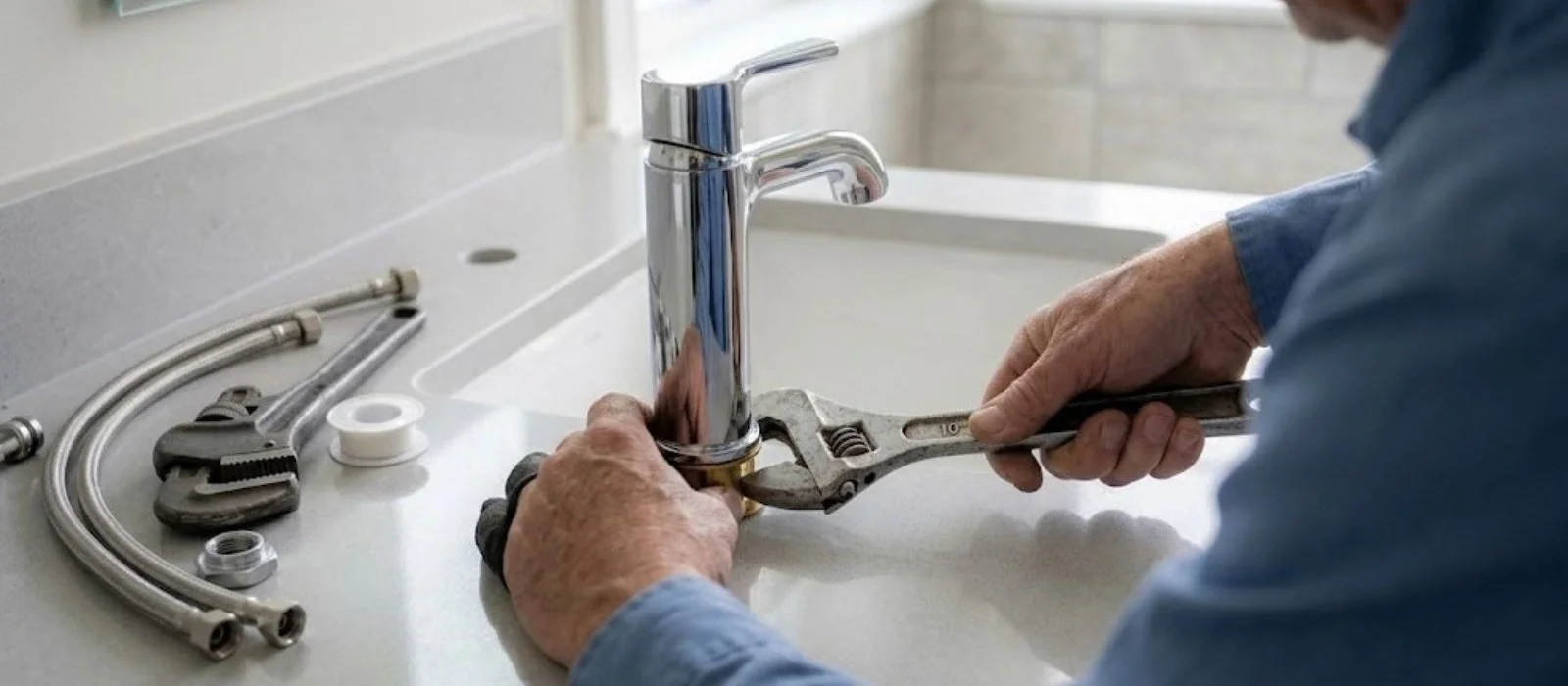
Supply valve stuck or burst under the sink
The small valve under a sink, called an angle stop, is the first line of defense when a fixture fails. When it works, you turn it clockwise and the water stops. When it is old, corroded or cracked, it may not budge, or it may leak at the handle the moment you touch it.
If the angle stop will not close
- Do not force it with pliers, since it can snap off and spray.
- Go to the main shut-off valve and turn it clockwise.
- Open a faucet at the lowest level to drain the pipes.
- Place a bucket and towels below, and photograph the valve.
Call the 24/7 line right away if
- Water is spraying or pooling and spreading.
- The main valve will not close either.
- Water has reached an outlet, a light or the panel.
- The cabinet floor is soft or the ceiling below is dripping.
Emergency repairs of this kind are common after a tight valve cracks or a braided line bursts at the nut. We answer at night and on weekends, and arrange same-day visits when the schedule allows. If the trouble is at the street, the curb stop belongs to the utility, so call MPWC water emergencies at (856) 663-0044.
Valve will not close?
Tell the dispatcher what you tried. We will help you isolate the water and plan the repair.
Dripping and leaking faucets: what is wearing out
A drip is a small sign of a worn part. Over a month, it can waste a surprising amount of water and leave mineral stains in the sink. The cause depends on the faucet type, so a plumber identifies the style before reaching for parts.
Leaks at the handle or the base usually come from a worn O-ring or cartridge. A leak from the spout points to a worn seat or washer. A faucet that slowly loses pressure may be clogged with mineral buildup inside the aerator or the cartridge.
| Faucet style | Common problem | Usual repair |
|---|---|---|
| Compression, two handles | Worn washer or seat, drip from spout | Replace washer and seat |
| Cartridge, single or two handle | Worn cartridge or O-ring, drip at the spout or handle | Replace the cartridge and rings |
| Ball type, often kitchen | Worn seals and springs, leaks at the base | Replace the repair kit |
| Ceramic disc | Mineral scale or cracked discs, hard handle | Replace the disc cartridge |
| Pull-down or pull-out kitchen | Hose, diverter or spray head failures | Replace the hose or diverter |
Kitchen, bathroom and laundry sinks
Kitchen sink
Heavy use wears faucets and hoses. Low flow from a pull-down sprayer is often a clogged aerator or a kinked hose, and leaks under the sink usually come from supply lines or the drain trap.
Bathroom sink
Pop-up drains, supply lines and cartridge faucets cause most calls. A slow drain is often hair on the stopper, not a bigger clog.
Laundry sink
Utility faucets sit on older valves and are often neglected. Replace brittle hoses and check the shut-off valves before they fail.
Outdoor spigots
A hose bib that drips behind the wall can damage the framing. Close it for cold weather and check the inside shut-off.
Shower valve leaks and showerhead problems
A showerhead that drips after you turn it off is usually a worn cartridge or a failed seat in the valve behind the wall. A weak, uneven spray is more often mineral scale in the holes, which soaking in vinegar can loosen. If the handle moves but the temperature will not change, the cartridge or mixing mechanism is worn.
If water stains appear on a ceiling or wall near a shower, that is a different category. Stop using the shower and call us, because a leak inside the wall needs leak detection before repairs, not guesswork.
Bathtub faucet repair
A tub spout that drips, a diverter that sends water to the spout when the shower is running, or a handle that spins without effect all come from a worn tub valve or diverter. Replacing the cartridge often fixes these. In some older homes the valve body is corroded and needs to be replaced, which means opening the wall behind the fixture.
Drip, squeal or stuck handle?
Tell us the faucet style and where it leaks. Many repairs are a cartridge or seal, and we plan the parts before we arrive.
Shower and tub drain clogs
Hair and soap scum are the usual culprits in a slow tub or shower drain. A drain cover, a plunger and a hair catcher handle many cases. When water backs up and does not drain, or other fixtures gurgle, the clog is deeper in the line, and our drain cleaning service is the right next step.
Repair or replace the fixture?
Repair is the right answer when the fixture is sound and a cartridge, seal or washer is worn. Replacement makes more sense when the finish is flaking, the body is corroded or the faucet is no longer made, so parts cannot be found. The cost of the part matters less than the age and condition of the whole fixture.
If you are replacing a faucet or want a fixture added somewhere new, see our plumbing installation page. For a toilet issue, we cover that on the toilet repair page. Homeowners in Maple Shade can call the same line for these fixes.
Check the plumber's license before work starts
New Jersey law says plumbing may be done only by a master plumber, an authorized plumbing contractor, or W-2 employees of one. Advertising and invoices must show the master plumber's name and license number. Ask for the number, then verify it with the State Board of Examiners of Master Plumbers, part of the NJ Division of Consumer Affairs.
Pennsauken fixtures, valves and water
In a township where the median home dates to 1964, under-sink shut-offs and supply lines have often been in place for decades. That makes a faucet repair a good time to replace the angle stops, since a failing valve is far easier to swap during a planned visit than during a flood.
Most Pennsauken addresses get their water from the Merchantville Pennsauken Water Commission, and some from New Jersey American Water. Ask your utility for its annual water quality report, and test your tap if you notice scale on fixtures, since mineral buildup is a common reason cartridges wear faster.
Source type: Census median year built and MPWC public pages
What affects the price of faucet and valve work
Faucet jobs run from a quick cartridge swap to a valve replacement inside a wall, so cost follows the work required.
Call the 24/7 line for phone triage. A licensed plumber then inspects the fixture, and you get a clear price before work starts.
Before we arrive
These small steps help the visit go quickly.
- Clear the cabinet under the sink and lay down a towel or tray.
- Take a photo of the faucet and any visible brand name.
- Note which handle or spout leaks, and when it began.
- Check whether the shut-off valves under the sink turn.
- Know where the main valve is, in case the angle stop fails.
Standards and rules behind this advice
The EPA WaterSense specification limits bathroom faucets to 1.5 gallons per minute, so a WaterSense aerator or faucet is a good replacement standard to look for. Faucets and supply parts that touch drinking water should be certified to NSF/ANSI 61.
Faucet, valve and fixture questions
Yes. A cracked supply line at night is exactly what the after-hours line is for. We guide the shut-off by phone and book the soonest same-day slot the schedule allows. We do not state an arrival time before looking at the day's open calls.
Do not force it. Shut the main valve instead, then call us. A seized angle stop usually needs to be replaced, and we install a new one so the next repair is easier.
Most often a worn cartridge, washer or O-ring. Mineral buildup can also keep a seat from sealing. A plumber identifies the faucet type, then replaces the right part. A repair is usually quicker than replacing the whole faucet.
Often, if the cartridge can be reached from the front. Older valves, or those with a corroded body, may require access from behind the wall. We explain the access before we begin.
A worn diverter is the usual cause. The part that sends water up to the showerhead no longer seals fully, so some flows out of the spout. Replacing the diverter or cartridge typically solves it.
Repair when the fixture is sound and a part is worn. Replace when the finish is failing, the body is corroded, or parts are unavailable. We tell you which makes more sense for your fixture.
Water that will not drain and spreads onto floors, or sewage backing up, is urgent. A single slow tub drain can wait for a daytime call. See our drain cleaning page for how we clear lines.