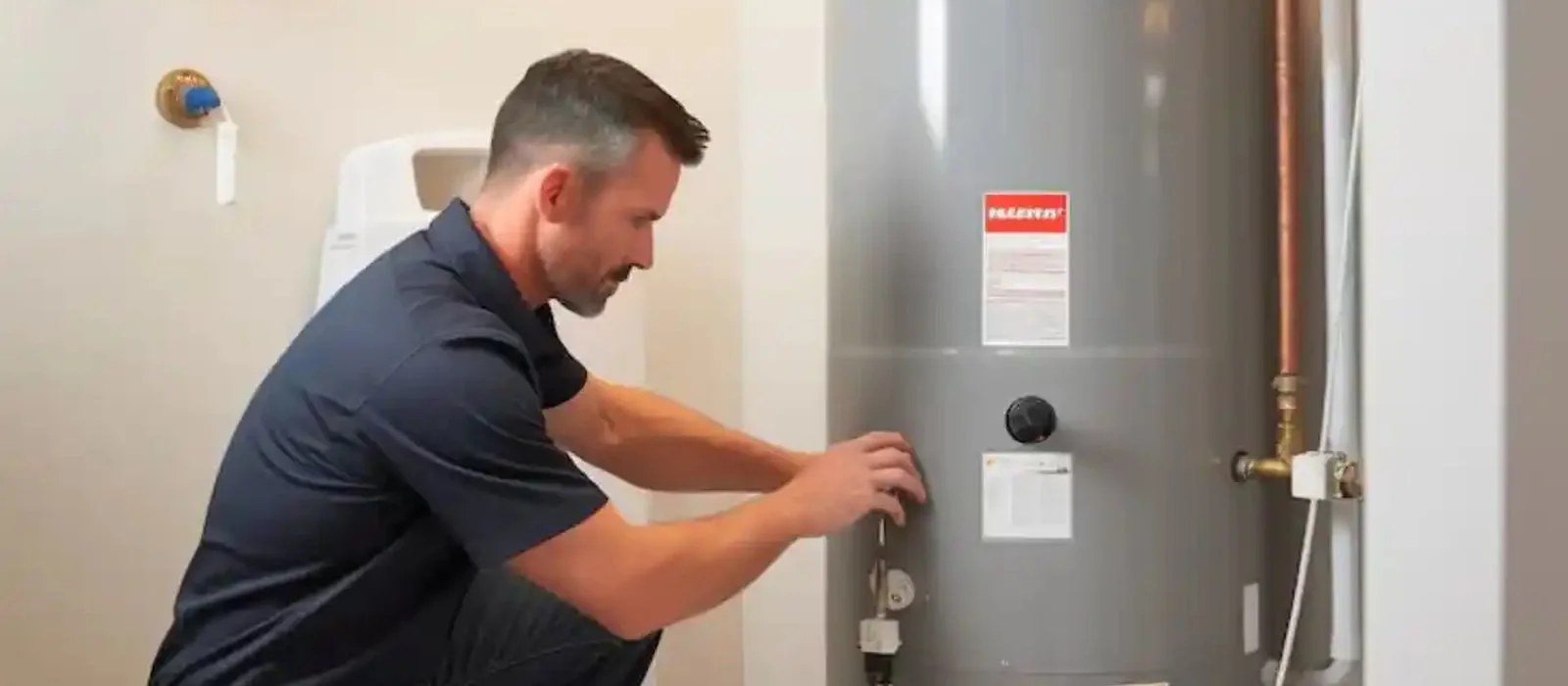
When a water heater problem is an emergency
Some faults can wait for a morning appointment. Water spreading from the tank across a finished floor cannot. Neither can steam or hot water pouring from the relief valve pipe, scorched wiring at the unit, or a rotten-egg or gas smell near the burner.
Tanks often give out overnight, when the house is quiet and nobody is watching the floor. The 24/7 line is answered at any hour, and after-hours or weekend visits are offered when the schedule allows. If you smell gas, leave the house and call the gas utility or 911 before anything else.
Shut-off steps while you wait for the plumber
Cut the fuel or power
On a gas unit, turn the gas control to off, but only if there is no gas smell. On an electric unit, switch off its breaker, and only if the panel area is dry and you can reach it safely.
Close the cold supply
Find the valve on the cold pipe entering the top of the heater. A lever handle shuts when it sits across the pipe, and a round wheel handle closes clockwise.
Relieve pressure upstairs
Open one hot faucet at the highest fixture in the house. This lets air in so the tank stops pushing water out of the leak.
Contain the water
Move belongings off the floor and use towels or a bucket. Do not step into standing water that reaches outlets, cords or the electrical panel.
Water heater leak: where the water is really coming from
A puddle under the heater does not always mean a dead tank. Fittings, valves and condensation can all put water on the floor, and each one has a different fix. Wipe the unit dry, then press a dry paper towel to each spot and see which one gets wet first.
The difference matters because a leaking connection is a short repair, while a leaking tank body cannot be patched. The wrong guess costs you either a needless new heater or another flood.
Tank body or base
Water seeping from the bottom, seams or the jacket, often with rust streaks. This points to a failed inner tank.
Supply connections
Drips at the pipes and flex connectors on top. These are usually tightened, re-sealed or replaced.
Relief valve and discharge pipe
Water or steam from the pipe beside the unit. The valve may be worn, or the tank may be running too hot or too high in pressure. Turn off the fuel or power and shut the cold supply, then call.
Drain valve at the bottom
A slow drip from the spigot near the floor. Sediment can hold it open, and plastic valves wear out.
| Where the water shows up | Likely cause | Usual direction |
|---|---|---|
| Under the tank, with rust at the base | Inner tank corrosion | Replacement. See water heater replacement |
| Top of the unit, dripping down the sides | Loose or worn supply fitting | Repair on site |
| Pipe beside the unit is running | Worn relief valve or excess pressure or heat | Test, then replace the valve or correct the cause |
| Small drip at the bottom spigot | Worn drain valve or sediment | Replace the valve, flush the tank |
| Floor wet but heater dry | Another pipe or condensation | Trace the source. See leak detection |
If the tank is emptying fast and water is reaching walls or ceilings below, handle it like a burst pipe and shut the main as well.
Water on the floor near the heater?
Shut off the fuel and the cold supply, then call the 24/7 line. A plumber can usually tell you by phone whether this sounds like a fitting or the tank.
No hot water: working through gas and electric faults in order
When the taps run cold, start with the energy source, then the heating parts, then the safety trips. Most no-hot-water calls come down to a tripped breaker, a failed element, a dead thermostat, or a gas burner that will not stay lit.
The table follows the order a plumber would test. It saves you from guessing, and it shows what is safe to look at before you call.
| Step | Gas heater | Electric heater |
|---|---|---|
| 1. Energy supply | Gas valve open, other gas appliances working | Breaker on, no tripped double-pole switch |
| 2. Ignition or heat | Pilot lit or igniter glowing, burner firing | Upper and lower elements drawing power |
| 3. Control parts | Thermocouple or flame sensor, gas control valve | Thermostats and the high-limit reset |
| 4. Safety trips | Blocked flue, draft problem, flame rollout switch | Overheat trip after a fault |
| 5. Who handles it | Plumber, always, for gas parts | Plumber for parts. Breaker check is yours |
Repair by heater type: gas, electric and heat pump hybrid
Gas units
A pilot that keeps dropping out usually means a weak thermocouple, a dirty pilot assembly, or a draft pulling the flame off. Poor venting is the one to take seriously, because combustion gases then spill into the room. Never relight a unit that has already failed twice without a technician looking at the flue.
Electric units
Two heating elements and two thermostats do the work. A failed lower element gives you short hot showers, while a failed upper element often means no hot water at all. The tank must be drained below the element before it comes out, so this is a plumber's job rather than a quick swap.
Heat pump hybrids
Hybrid units add a compressor and fan on top of the tank, with electric elements as backup. Early checks are the air filter, the condensate drain and clearance around the intake. Error codes differ by maker, so have the model name ready when you call.
Water heaters in Pennsauken, NJ basements and utility rooms
The median home in Pennsauken was built in 1964, and the oldest stock sits in the south of the township, in areas like Delair. Homes of that era often keep the heater in a basement, garage or utility closet, where a slow leak can run for days unseen.
So check the floor and the drain pan under your unit every few months, and confirm the pan has a line that actually runs to a drain. A dry pan today is the cheapest warning you will get.
Source type: US Census American Community Survey, median year built
What affects the price of a water heater repair
A repair price depends on what failed and how hard it is to reach. A quick fitting fix and an element replacement on an older tank sit at very different ends.
You describe the problem by phone and we triage it. After the plumber diagnoses the unit, you get a clear price before work starts, and you decide whether to proceed.
What to have ready when you call
A few details let the dispatcher plan the right parts.
- Brand, fuel type and tank size from the data plate
- Where the heater sits and how to reach it
- What you see: leak, no heat, noise, smell or an error code
- Whether you have shut off the fuel or power and the cold supply
- Approximate age, or the date code on the plate
Not sure if it is worth fixing?
Tell the dispatcher the age and symptoms. You will hear plainly whether repair or replacement makes more sense.
Standards and rules behind this advice
Gas-fired storage heaters are listed to the ANSI Z21.10.1 standard, which is why a plumber replaces safety parts such as the relief valve with listed ones rather than improvising. According to the manufacturer's manual for your model, any burner or venting work needs the exact approved parts.
Water heater repair questions answered
Yes. The 24/7 line is answered around the clock, including nights, weekends and holidays. Same-day and after-hours visits depend on the schedule at the time. We cannot promise an arrival time, but the dispatcher will tell you honestly what is available and what to shut off while you wait.
It may be the tank body, a supply fitting, the relief valve or the drain valve. Tank-body leaks mean replacement, while the others are normally repairs. A plumber can tell which by looking at where the first drop forms.
If the floor is wet but the heater is dry, the water may be coming from another line. A leak detection visit traces that.
It can be. The valve opens when pressure or temperature climbs too high, so a running pipe is a warning. Turn off the fuel or power, shut the cold supply, keep clear of the discharge because the water can scald, and call. Do not cap the pipe.
You can try once if you follow the label on the unit and smell no gas. If it drops out again, the thermocouple, the pilot assembly or the venting needs attention, and that is a technician's job.
Rumbling or popping usually means sediment baked onto the bottom of the tank, with water boiling beneath it. A flush can help on a younger unit. On an older one it may point toward replacement.
A gas or sulfur odor means leave the house and call the gas utility or 911 first. A burnt smell on an electric unit means switch off its breaker if the panel area is dry. Then call us for the repair once the area is cleared.
Yes. Neighboring towns such as Maple Shade and Cherry Hill are covered from the same 24/7 line, so give the dispatcher your address when you call.