Service line leak emergency: signs and first moves
Your service line is the underground pipe between the utility's connection near the street and your meter or foundation. When it leaks, the water often goes down instead of up, so the evidence is indirect. A leak detection visit can confirm it before any digging.
Wet or sunken ground
A patch of lawn that stays soft, a sinking driveway edge or a bubbling sidewalk joint can mark the spot.
A meter that keeps turning
If the dial moves with every fixture off and the leak stops when the indoor main closes, the loss sits between the meter and the house.
Pressure that fades
Showers that weaken and faucets that sputter, with no clog, can mean water is leaving the line before it reaches you.
Muddy or rust-tinted water
Sediment pulled into a broken line, or disturbed rust in an old steel pipe, can tint the tap.
If water is flooding a basement or pooling at the foundation, shut the main valve and call right away. After-hours calls get the same triage as daytime ones, and we schedule a same-day visit when availability allows. If it looks like a break at the street valve or on the utility's side of the meter, call MPWC water emergencies at (856) 663-0044.
Soggy yard or a meter that will not stop?
We work out which side of the meter the problem is on, then plan the repair.
What your service line is made of, and why age matters
Service lines depend on age. A line installed decades ago is likely a different material from one put in during a recent upgrade, and the material shapes both the failure and the repair. You cannot tell by looking at the yard, but the pipe where it enters your basement often reveals it.
| Material | Where it shows up | What to know |
|---|---|---|
| Copper | Common in homes updated or built in the copper era | Durable, but can pit or split, and joints may fail over time |
| Galvanized steel | Older homes of the mid-century era | Rusts from the inside, narrows the bore and weakens the walls |
| Lead | Possible in the oldest service lines | Needs special attention, covered in the next section |
| PEX or HDPE | Newer or replaced lines | Flexible, resists corrosion, requires correct fittings and bedding |
Lead service line replacement
Some older service lines contain lead, and the water utility is the best source on what is known about yours. MPWC publishes a Lead Service Line inventory and FAQ resources at mpwc.com. Ask them how it applies to your address, and whether the line on their side and the line on your side have been identified.
If your line is lead or suspected lead, a plumber can replace the homeowner side with a modern material. Coordinating with the utility matters, because a partial swap should be planned with them first. We explain the plan and the permit steps before we begin.
Low water pressure: how to tell if the line is the cause
Not every pressure problem is a leak or a bad service line. A short checklist rules out the simple causes before anyone digs.
- Check whether low pressure hits every fixture or only one. A single weak tap is usually an aerator or cartridge, not the main.
- Look at the main valve and any meter-side valve. A gate valve that is only partly open throttles the whole house.
- Find the pressure regulator, if there is one, a bell-shaped brass fitting near the main. A tired regulator can cut flow or let pressure spike.
- Think about galvanized plumbing. Rust buildup narrows older steel pipe, so flow drops gradually at the farthest fixtures.
- Ask a neighbor, or the utility, whether pressure is low on your street. That points away from your own line.
If those checks come up clean, a pressure gauge on a hose bib shows what the house is getting, and a leak test finds out whether the service line is losing water. Replacing a failing line or fixing a regulator often restores the flow in one visit.
Repair or replace the line?
A spot repair fits when
- One clear leak sits in an otherwise sound pipe.
- The pipe material is in good condition at the cut.
- The leak is in a place that can be reached with a small excavation.
- There is no history of earlier leaks along the same run.
Replacement is the better call when
- The line is old galvanized steel or suspected lead.
- Repairs have already been made once or twice.
- The pipe shows pitting, flaking or heavy buildup inside.
- Pressure has been poor for a long time and a repair would not fix it.
Trench or trenchless: how the work gets done
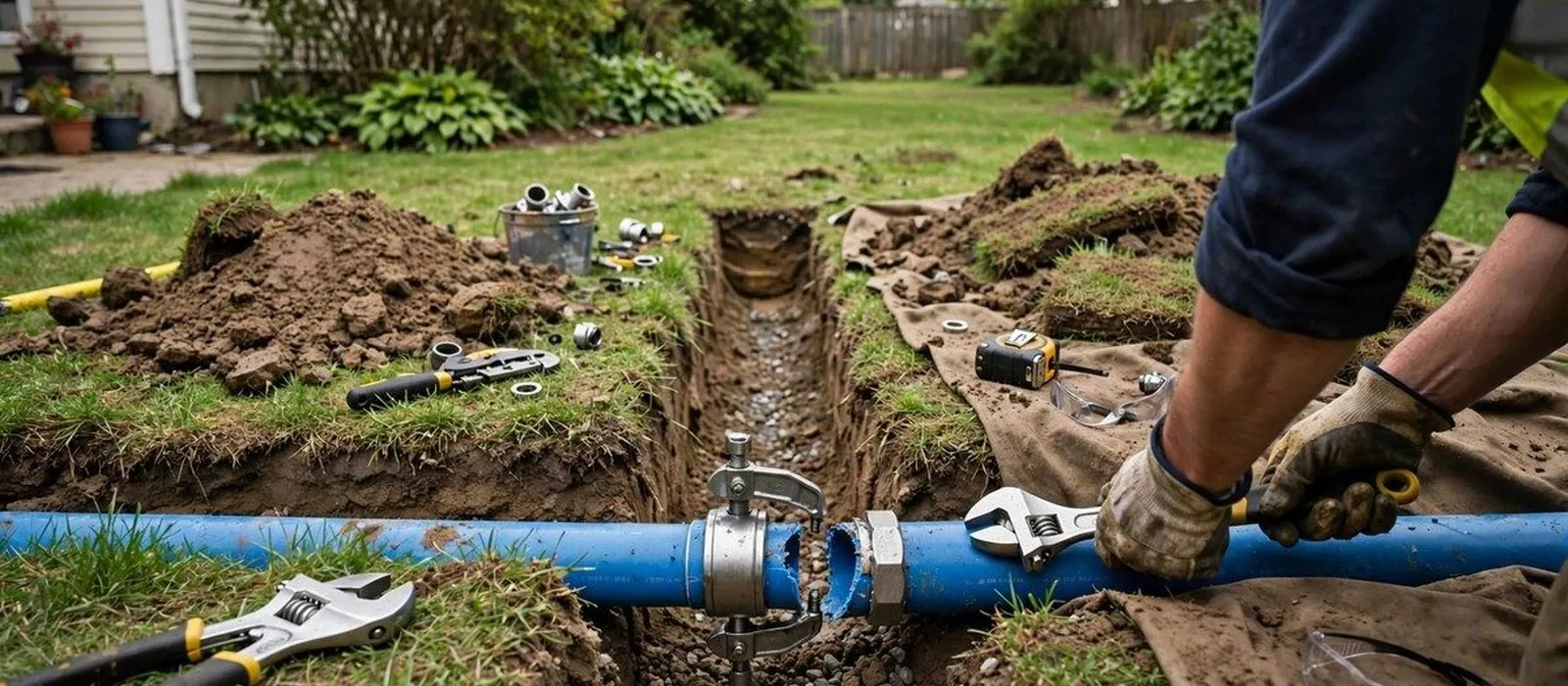
A trench is the standard method. We dig down, expose the pipe, replace or repair it, and backfill. It gives full access and lets us inspect the bedding, but it disturbs the lawn, walkway or pavement above.
Trenchless methods, like pulling or bursting a new pipe through the old path, can reduce surface damage. They are not suitable for every site, since depth, soil and the path of the old line all matter. We tell you which one fits your property before we price it.
Planning a line replacement?
Tell us the age of the home and where the pipe enters. We will explain what it takes and what the utility handles.
Where the utility ends and your pipe begins
The curb stop at the street and the water meter belong to the utility. In Pennsauken that is usually the Merchantville Pennsauken Water Commission at 6751 Westfield Ave, though a few addresses are on New Jersey American Water, so check your bill. Neighbors across the creek in Cinnaminson are on New Jersey American Water, which changes who you call. Your responsibility starts at a point they can confirm for your address.
That matters because digging up the wrong stretch wastes money, and a utility-owned fault should not be on your invoice. The township Construction Code Department at 2400 Merchantville Ave handles permits for plumbing work, and we tell you at the start whether a permit applies.
Source type: Merchantville Pennsauken Water Commission and Township of Pennsauken public pages
New service lines for additions and new builds
Adding a building, splitting a property or moving the meter location calls for a new service line, and that is planned work rather than an emergency. Plumbing installation and new construction involve sizing the line for the house, coordinating with the utility, and pulling the permit. See our plumbing installation page for how those projects run.
What affects the price of water line work
Service line jobs vary more than almost any plumbing task, because most of the cost is hidden underground.
A phone call comes first, then a plumber evaluates the line. You get a clear price before work starts, and the scope is written down so you know what is included.
Before the crew arrives
A little preparation keeps the visit short and the digging in the right place.
- Clear the path between the street and the house, including cars, pavers and planters.
- Know where the main shut-off valve is inside the house.
- Locate any irrigation heads, invisible fence wires or buried tanks.
- Have a recent water bill handy, so we can see which utility serves you.
- Plan for a short water shutoff, and fill a few containers if you need them.
If you are unsure whether the leak is in the service line at all, our leak detection work comes first. For breaks inside the house, see burst pipe repair.
Standards and rules behind this advice
Components that touch drinking water are certified to NSF/ANSI 61, and the federal Lead and Copper Rule governs how water systems deal with lead service lines. The Merchantville Pennsauken Water Commission publishes a lead service line inventory and FAQ, so ask it how the rules apply to your address.
Water line questions answered
Yes, the line is staffed overnight and on weekends. A dispatcher helps you decide whether the problem is yours or the utility's, and books a same-day visit if the schedule has room. Arrival times are not promised. Street-side faults go to MPWC at (856) 663-0044.
Close the main valve inside the house and watch the meter. If it stops moving, the leak is inside. If it keeps moving, the loss is between the meter and the shut-off valve, or on the utility side. Ask your utility to check the meter and the curb stop.
It depends on the age of the line and when it was last replaced. MPWC publishes a Lead Service Line inventory and FAQ resources at mpwc.com. Ask them how it applies to your address, and have a plumber look at the pipe where it enters the house.
Often yes. A partly closed valve, a failing regulator, a clogged fixture or old galvanized buildup are all common causes. We test pressure first. If the service line itself is the problem, replacement may be the real fix.
Those belong to the utility, so contact them first. If the fault is on your side of the connection, the repair is yours. We help you sort out which side it is before work begins.
It depends on the length and method, so we cannot give a fixed time. We tell you before work starts when the water will go off, and we try to restore service as soon as the new line is tested.
Plumbing work in Pennsauken is generally handled through the township Construction Code Department, and coordination with the water provider may be needed. Ask them for the current requirements for your address, and we guide you through our part.