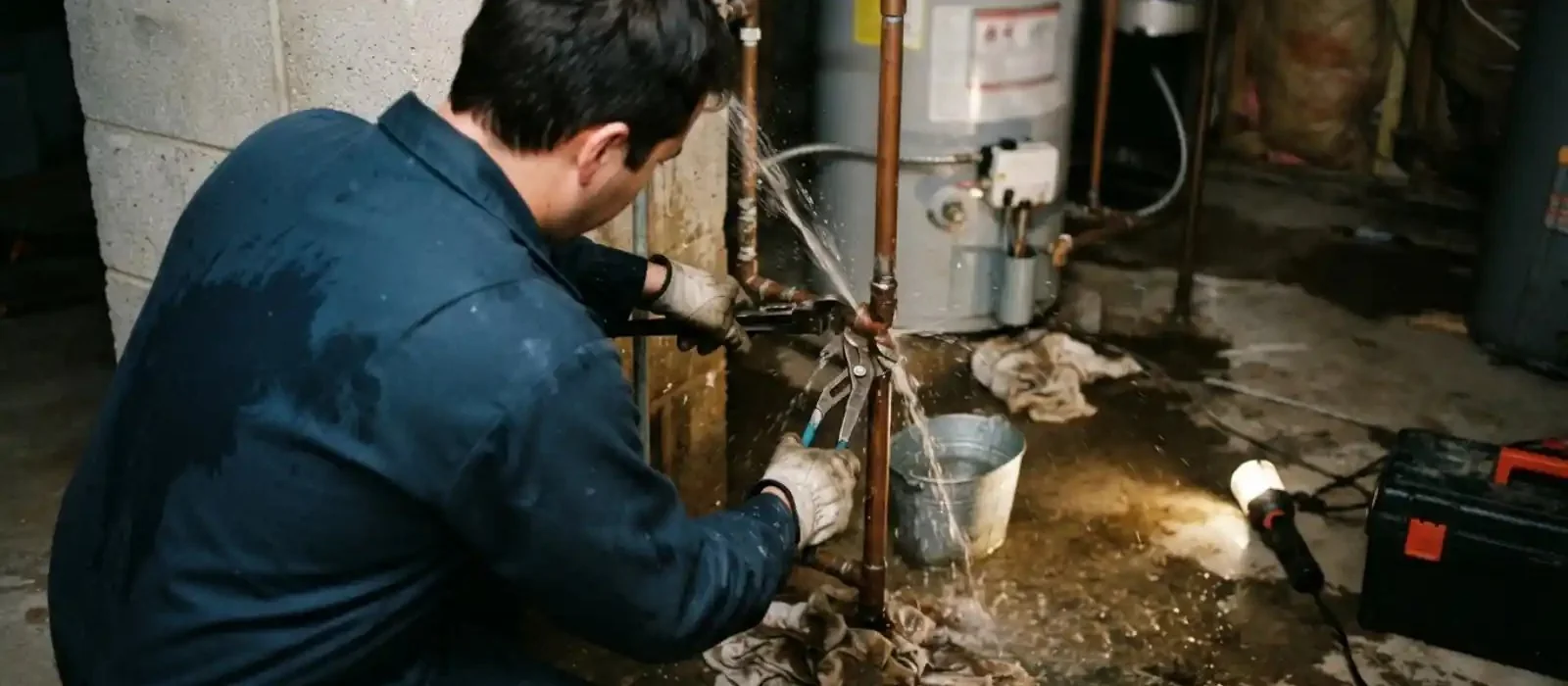
Where pipes freeze in a Pennsauken house
The National Weather Service defines a freeze as air temperature below 32 degrees Fahrenheit. Pipes do not freeze the moment the air hits that mark, but long cold spells and wind get them there. The risky spots are the ones the heat does not reach.
Census survey data puts the median year built for Pennsauken homes at 1964. Homes of that era often have supply lines in exterior walls, crawlspaces, garages and unfinished basements, which are the usual trouble spots.
Exterior walls
A line run against an outside wall sits next to the cold. Kitchen and bath sinks on exterior walls are the classic example.
Crawlspaces and basement corners
Where the water service enters through the foundation, the pipe is exposed to cold air leaking in. A gap in the rim joist can be enough.
Garages and attached sheds
Water lines that cross an unheated garage are exposed when the door stays open or the space is not insulated.
Hose bibs
A hose left connected traps water in the spigot and the pipe behind it. The freeze often splits the pipe inside the wall, where you cannot see it.
Signs a pipe has frozen
- Only a trickle comes out of a faucet, or nothing at all.
- Frost is visible on a pipe in a crawlspace or basement.
- One fixture is dead while others work, which points to a local freeze.
- A pipe feels extremely cold, or bulges slightly.
- You hear water hissing or dripping near a frozen section after it starts to thaw.
How to thaw a frozen pipe step by step
Open the faucet
Leave the tap open so water can flow as the ice melts. Moving water also helps clear the blockage.
Apply gentle heat
The American Red Cross lists an electric hair dryer, a heating pad, a portable space heater kept away from anything flammable, or towels soaked in hot water. Keep heat on until full pressure returns.
Never use open flame
Do not use a blowtorch, propane or kerosene heater, or any open flame device. Fire risk, scorched framing and pipe damage are all real.
Check the other taps
One frozen pipe often means others are frozen too. Test every faucet before you assume the problem is solved.
Stop and call
If you cannot find the frozen section, cannot reach it or cannot thaw it, call a licensed plumber rather than escalating the heat.
Pipe frozen and you cannot reach it?
Close the main if you see water. The 24/7 line is answered when the weather turns, and same-day appointments are offered when available.
When a frozen pipe has already split
A split pipe can sit quiet until the ice melts, then leak heavily. If you see water on a ceiling, a wet wall or a puddle near a once-frozen pipe, treat it as a burst. Close the main shutoff, open a faucet at the lowest point to drain the line, and keep clear of wet outlets.
A fresh split is the work of burst pipe repair, which usually means cutting out the damaged section and replacing it. Do not wait for the leak to slow down, because lines under pressure rarely stop on their own.
| What you notice | Likely state | What to do now |
|---|---|---|
| Trickle at one faucet, no water marks | Frozen, not split | Open the tap and thaw gently |
| Frozen section found, now water is dripping | Split during thaw | Close the main and call |
| Wet ceiling or wall after a cold night | Burst inside the structure | Main off, power safe, call |
| Hose bib frozen and indoor valve exists | Exterior spigot at risk | Close the inside valve, then open the bib to drain |
| Pipe thawed, pressure normal | Likely fine | Watch for slow leaks, then check the meter |
Preventing the next freeze
Before the next cold snap
These steps come from Red Cross winter guidance and basic plumbing practice.
- Close the inside valve to each outdoor hose bib, then open the outside spigot so the line drains.
- Insulate pipes in garages, crawlspaces and under cabinets. Pipe sleeves or UL listed heat cable can help.
- Open cabinet doors under sinks on exterior walls so warm air reaches the pipes.
- In very cold weather, let cold water drip from faucets fed by exposed pipes.
- Keep the thermostat steady day and night, and if you travel, keep the heat on at no lower than 55 degrees Fahrenheit.
- Know where your main shutoff is and that every adult in the house can find it.
After a freeze, a slow leak may follow. If your meter keeps moving once everything is off, leak detection can trace the loss before it damages drywall.
Pennsauken water emergencies: who to call about the water supply
The Merchantville Pennsauken Water Commission serves most addresses in the township, and a few may be on NJ American Water, so check your bill. The commission lists a 24-hour operator for water emergencies at (856) 663-0044 and an office line at (856) 663-0043 on weekdays. If water is coming up in the street or the whole block is dry, that is a utility problem and not a pipe in your house.
The commission's website does not give shutoff valve instructions, so find your own main before winter. Look where the service line enters the house, often near the foundation, which is also a common freeze spot. Knowing its location turns a flood into a short mess.
Source type: Merchantville Pennsauken Water Commission public website and National Weather Service definitions
Houses in Cinnaminson and Collingswood face the same cold snaps, and the same thaw rules apply there.
Standards and rules behind this advice
According to the National Weather Service, a freeze means air temperature at or below 32 degrees Fahrenheit, and American Red Cross guidelines cover safe thawing.
Frozen pipe questions
Often yes, if you use gentle electric heat and keep the faucet open. A hair dryer or heating pad works. Never use a torch or open flame.
Stop if you cannot find the frozen section, if the pipe is in a closed wall, or if you see a crack or water.
No. Many freeze and thaw without damage, especially when the cold is brief. The risk is highest where ice has expanded against a rigid section or a fitting.
A pipe that froze once is worth inspecting, since a weak spot can leak later.
If the pipe is only frozen and you are thawing it, keep the faucet open. If it has split or you see water, close the main shutoff right away.
Then open a tap at the lowest point to drain the line while you wait.
The 24/7 line is answered at any hour, including weekends and holidays. Same-day scheduling depends on availability, and there is no promised arrival time.
While you wait, shut the main, keep away from wet outlets and move valuables off wet floors.
Call the Merchantville Pennsauken Water Commission's 24-hour operator at (856) 663-0044. That line covers the utility side, including problems with the water main in the street. Have your address and the nearest cross street ready when you call.
If water is flowing only in your house, a licensed plumber handles the pipes inside.