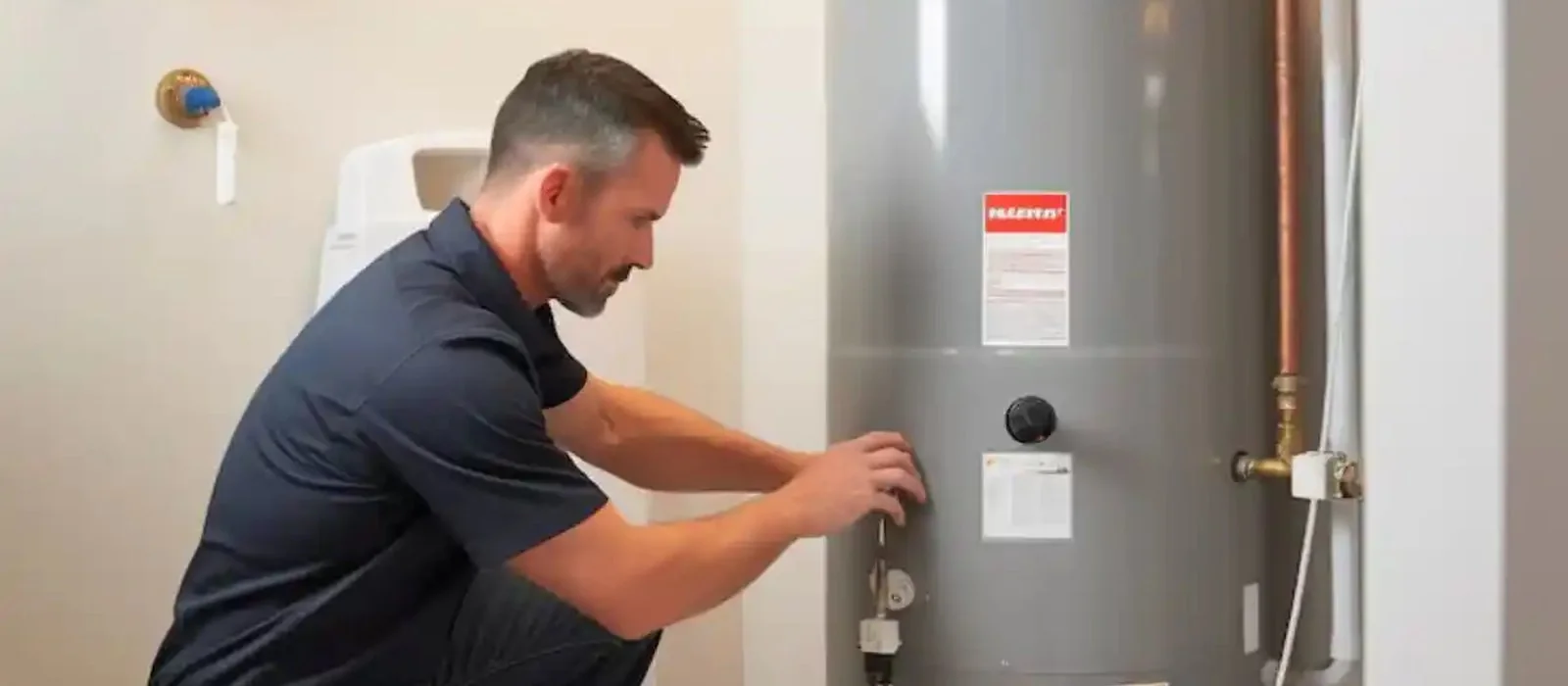
What the anode rod actually does
Water in a steel tank slowly attacks the metal. The anode rod is made of a more reactive metal, so the water attacks the rod first. As long as the rod has material left, it takes the damage and the tank wall lasts longer.
When the rod is mostly gone, that protection ends and corrosion moves to the tank itself. This is why a worn rod is cheap protection and a rusted tank is a replacement.
Signs the rod or the tank needs attention
Rumbling or popping
Sediment on the tank bottom traps water that boils and bursts through the layer. Flushing often quiets it.
Rusty or smelly hot water
Discolored hot water that clears on cold taps points toward the tank or the rod. A sulfur smell can also be tied to the rod reacting with water chemistry.
Less hot water than before
Sediment reduces usable tank volume and insulates the burner or element from the water.
Moisture around the base
A leaking tank is past saving with a new rod. Turn off power or fuel and the cold supply, then call.
How to inspect the rod
Read your manual first
Bradford White's FAQ says recommended maintenance is listed in the service manual provided with your heater, and that it recommends a plumbing professional do the work.
Shut off power or fuel and cold water
For electric models, turn off the breaker. For gas, set the control to off. Close the cold supply valve before opening anything on the tank.
Lift the rod out and look
The rod threads into the top of the tank, often under a cap or a hex head. A rod that is thin, pitted or showing bare steel wire has little left. A solid rod with a light coating is doing fine.
Replace or reinstall
Fit a new rod with the right thread sealant per the manufacturer, then refill and purge air before power returns.
Rod seized or the tank is leaking?
A stuck rod can twist the tank, and a wet base is an emergency. The 24/7 line is answered at any hour.
Flushing the tank: why the drain valve matters
Bradford White states that water heaters are generally not self-cleaning, and that even its sediment-reducing design does not replace the need to periodically drain the tank. Sediment forms from minerals in the water and settles on the bottom. A flush removes the loose layer.
A stuck or clogged drain valve is common on older tanks. If the valve will not open or leaks after, stop and call, because forcing it can cause a leak that is worse than the sediment.
| Situation | Sensible step | Why |
|---|---|---|
| Tank is young, no leaks, hot water normal | Inspect rod, flush if sediment noise | Cheap upkeep protects a good tank |
| Rod gone, tank otherwise sound | Replace the rod and flush | Restores protection |
| Rusty hot water, no leak | Inspect rod and tank interior condition | May be the rod, may be the tank |
| Moisture or rust at the base | Plan a replacement | A leaking tank cannot be repaired |
| Old tank, rod seized in place | Weigh replacement against the risk of damage | Forcing it may start a leak |
Hybrid and tankless units are different
Heat pump (hybrid) water heaters still have a storage tank, so a rod and flush apply, but they also need the right space. DOE says the location should stay between 40 and 90 degrees Fahrenheit year-round and have at least 1,000 cubic feet of surrounding air. DOE also recommends a qualified professional for installation.
Tankless units have no storage tank, so no rod in the same sense. Mineral scale can build up inside the heat exchanger instead, and the manufacturer's manual sets the descaling routine. Our water heater repair team services all three kinds.
Pennsauken water chemistry: look up your own numbers
The Merchantville Pennsauken Water Commission draws its supply from wells in the Potomac-Raritan-Magothy aquifer and publishes an annual water quality report. The commission's page did not list a hardness figure that we could read, so we do not state one. Call its office at (856) 663-0043 on weekdays or open the report online and look for hardness and mineral levels.
A few addresses may be on NJ American Water, so check your bill and ask that utility for its report. Hardness and minerals decide how fast sediment builds and how quickly a rod wears. A home with harder water usually benefits from checking the rod and flushing more often.
Source type: Merchantville Pennsauken Water Commission water quality page, Bradford White manufacturer FAQ, U.S. Department of Energy heat pump water heater page
When replacing the heater beats replacing the rod
A new rod makes sense when
- The tank has no leaks, rust stains or wet insulation.
- The unit is still within the age range your manual calls normal.
- Hot water output and recovery are still fine.
- The rod can be reached and removed without forcing it.
Plan a replacement when
- Water appears at the base or the tank seams.
- The heater is old and repairs keep stacking up. See water heater replacement for options.
- Rust-colored hot water persists after a flush.
- The drain valve or rod is stuck so hard that service risks damage.
Homes in Cherry Hill and Cinnaminson are on different water systems, so ask your own utility for its numbers. The cost to service a heater depends on the model, access to the top fittings, the condition of the drain valve and whether the rod is stuck. A price is given after phone triage and before work starts.
Standards and rules behind this advice
According to the water heater manufacturer's manual, tank maintenance steps vary by model, and gas units are built to ANSI Z21.10.1.
Anode rod and flushing questions
There is no single date. It depends on water chemistry, usage and the rod material. Follow the maintenance schedule in your heater's manual and inspect the rod periodically.
If the rod is thin, pitted or coated with calcium, replace it.
Many homeowners can drain a tank through the valve at the bottom into a hose, once the power or fuel and cold supply are off. Manufacturers often recommend a professional, as Bradford White does.
Stop if the valve sticks or leaks.
No. A rod protects the tank wall from corrosion. It cannot seal a hole or cracked seam.
Moisture on or around the tank means you should plan a replacement. Shut off the power or fuel and the cold supply first, then call for an assessment.
Generally not, since they have no storage tank. They deal with mineral scale in the heat exchanger instead.
Descale on the schedule in the manual, especially if your water carries minerals. Hybrid units are different, since they keep a tank, so a rod and flush still apply there.
Ask the Merchantville Pennsauken Water Commission for its annual water quality report, or call (856) 663-0043 on weekdays. Addresses on NJ American Water should ask that utility.
You can also test a tap sample yourself with a home kit, then compare the result with the report.