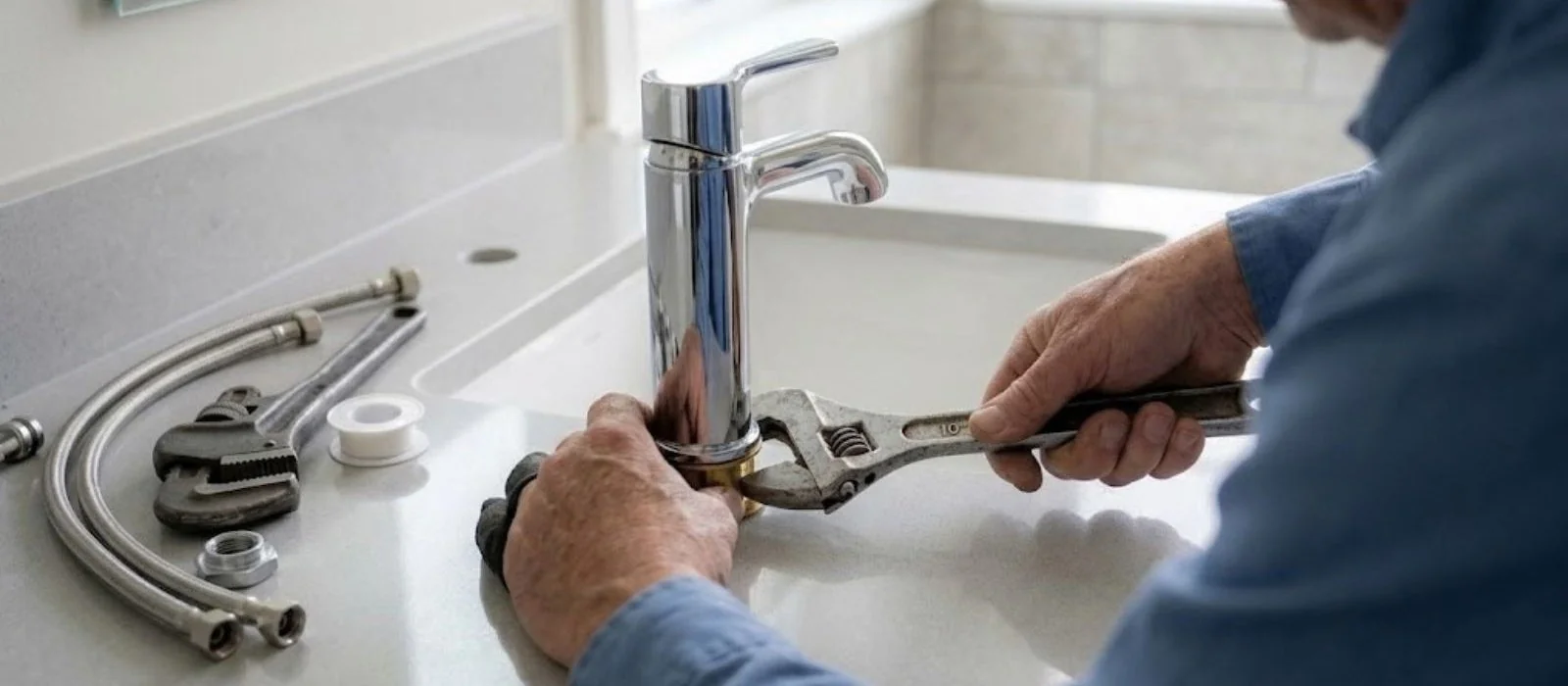
Start with the handle: which kind of faucet do you have?
The repair depends on how the faucet is built, so look at the handles first. Two separate handles that turn several times before the water stops are compression faucets. One lever or knob that moves up, down, and side to side is almost always a cartridge or ball style.
Homes in Pennsauken have a median build year of 1964, so homes of that era often still have a mix of original and replaced fixtures. A bathroom may hold a decades-old two-handle set next to a newer single lever. Treat each faucet as its own repair.
Why bathroom faucets drip and what each part does
| What you notice | Likely cause | Usual fix |
|---|---|---|
| Steady drip from the spout, two handles | Worn rubber washer or pitted valve seat | Replace the washer, resurface or replace the seat |
| Drip from a single-lever faucet | Worn cartridge or damaged O-rings | Replace the cartridge or the O-ring set |
| Water leaks around the base of the handle | Dry or cracked O-ring, loose packing nut | Replace O-ring or tighten and repack |
| Weak flow or spray goes sideways | Mineral buildup in the aerator | Unscrew, soak or clean, or replace the aerator |
| Handle turns but water barely changes | Worn cartridge stem or failed stop valve | Replace cartridge, then test the stop valve |
| Drip returns after a repair | Seat is scored or the wrong part was used | Match the part by model, replace the seat or the faucet |
Washers and O-rings are small rubber parts that press against metal every time you shut the water off. Over time they harden, crack, or flatten, and water slips past. A cartridge is a sealed unit that does the same job in a single-handle faucet, which is why replacing it often cures several symptoms at once.
Cartridge, washer, or aerator: how to tell them apart
Washer and seat problems
A drip that starts after you close the handle firmly points to the washer. Pitted metal under the washer chews up a new washer quickly, so a repeat drip means the seat needs attention too.
Cartridge problems
A single-handle faucet that drips, runs hot when set to cold, or feels loose is usually a worn cartridge. The replacement must match the brand and model, so photograph the faucet and keep the old cartridge for comparison.
Aerator problems
The aerator is the small screen at the tip of the spout. When grit or mineral flakes block it, flow weakens or the stream splits, but the faucet does not usually drip because of it.
Not sure which part failed?
Describe the drip over the phone and the dispatcher can tell you whether it sounds like a quick part swap or a deeper fixture problem.
Shutoff valves: the step that decides how the repair goes
Every bathroom sink should have two small stop valves under it, one for hot and one for cold. Turn each clockwise until it stops, then open the faucet to confirm the water has really quit. If water keeps running, the stop valve is not sealing.
Valves that have not been turned in many years can seize or break when forced. Do not keep cranking. Shut the main water valve for the house instead and have the stop valves replaced as part of the job.
Worth knowing about a slow drip
The U.S. EPA reports that a faucet dripping once per second can waste more than 3,000 gallons a year. A drip also stains the basin over time.
A careful DIY repair, step by step
Close the stop valves and drain the line
Turn off both stop valves, then open the faucet to release pressure.
Remove the handle and trim
Pry off the cap, remove the screw, and lift the handle.
Pull the worn part and match it
Take the washer, O-ring, or cartridge to a hardware store, or look up the faucet model. Parts that are close but not exact often leak again.
Reassemble and test slowly
Open the stop valves partway, then fully, and check for drips at the handle and under the sink.
Reasonable to do yourself
- Cleaning or replacing an aerator
- Swapping a washer or O-ring on a faucet with working stop valves
- Replacing a cartridge when you can identify the exact model
- Tightening a loose handle or packing nut
When to call a plumber
- A stop valve will not close or leaks when touched
- Corroded or crumbling supply lines under the sink
- Water staining or soft cabinet floors below the sink
- The fixture is old enough that parts are no longer made
- You want the faucet replaced rather than repaired
When a repair is not worth it
A cartridge or washer swap is a small job on a sound faucet. It makes less sense on a faucet with a worn finish, a cracked body, or parts that cannot be found. A plumber can compare the repair against installing a new faucet and explain the cost drivers before any work begins.
If repeated fixes keep failing, a plumber doing faucet repair can compare the options on site. If the sink also drains slowly, the trap may need drain cleaning while the cabinet is open. Plumbers who serve Collingswood and Cherry Hill handle these same repairs.
What affects the price of faucet repair
A faucet repair is not priced from a table. The final number depends on what is actually wrong, and a good plumber confirms that before starting.
The price is given by phone after a short triage and again before work starts, so there is no surprise at the sink.
What Pennsauken homeowners should know about water and faucets
Most Pennsauken addresses are supplied by the Merchantville Pennsauken Water Commission, and a few may be on New Jersey American Water, so check your bill. MPWC draws from wells in the Potomac-Raritan-Magothy aquifer and publishes an annual water quality report on its website.
The reports are where to look for hardness. Mineral scale is a common reason aerators clog, so if you see white flakes in the screen, ask MPWC for the hardness in its report or test your tap before choosing a faucet finish. If you suspect a problem on the street side of your meter, MPWC lists a 24-hour water emergency number on its website.
EPA also suggests a simple leak test: read the water meter, use no water for two hours, then read it again. If the reading moved, something is leaking.
Source type: Merchantville Pennsauken Water Commission public pages and U.S. EPA WaterSense public pages
Standards and rules behind this advice
EPA WaterSense guidelines set bathroom faucets at 1.5 gallons per minute or less, and WaterSense publishes a household leak check using your meter.
Bathroom faucet repair questions
The sealing part inside has worn out. In a two-handle faucet that is usually the washer or valve seat, and in a single-handle faucet it is usually the cartridge or its O-rings.
Mineral buildup can also keep the seal from closing fully. A new part on a scored seat will drip again, so inspect the metal before reassembling.
Yes, if the small stop valves under the sink close fully. Test them by opening the faucet after you turn them off. If water keeps flowing, the valves are failing.
Do not force a seized valve. Shut off the main and call a plumber for faucet repair to replace the stop valves.
Replace it when the body is cracked, the finish is flaking, repairs keep failing, or matching parts cannot be found. A faucet with a corroded base can also leak under the sink where you cannot see it.
A plumber can tell you the cost drivers for both options by phone before any work starts.
Check whether other fixtures in the house are also weak. If only one faucet is low, clean its aerator first. If every fixture is weak, the issue may be a partly closed main valve or something on the street side.
MPWC lists a 24-hour water emergency line on its website for supply problems. If the cause is inside the home, call us and describe which fixtures are affected.