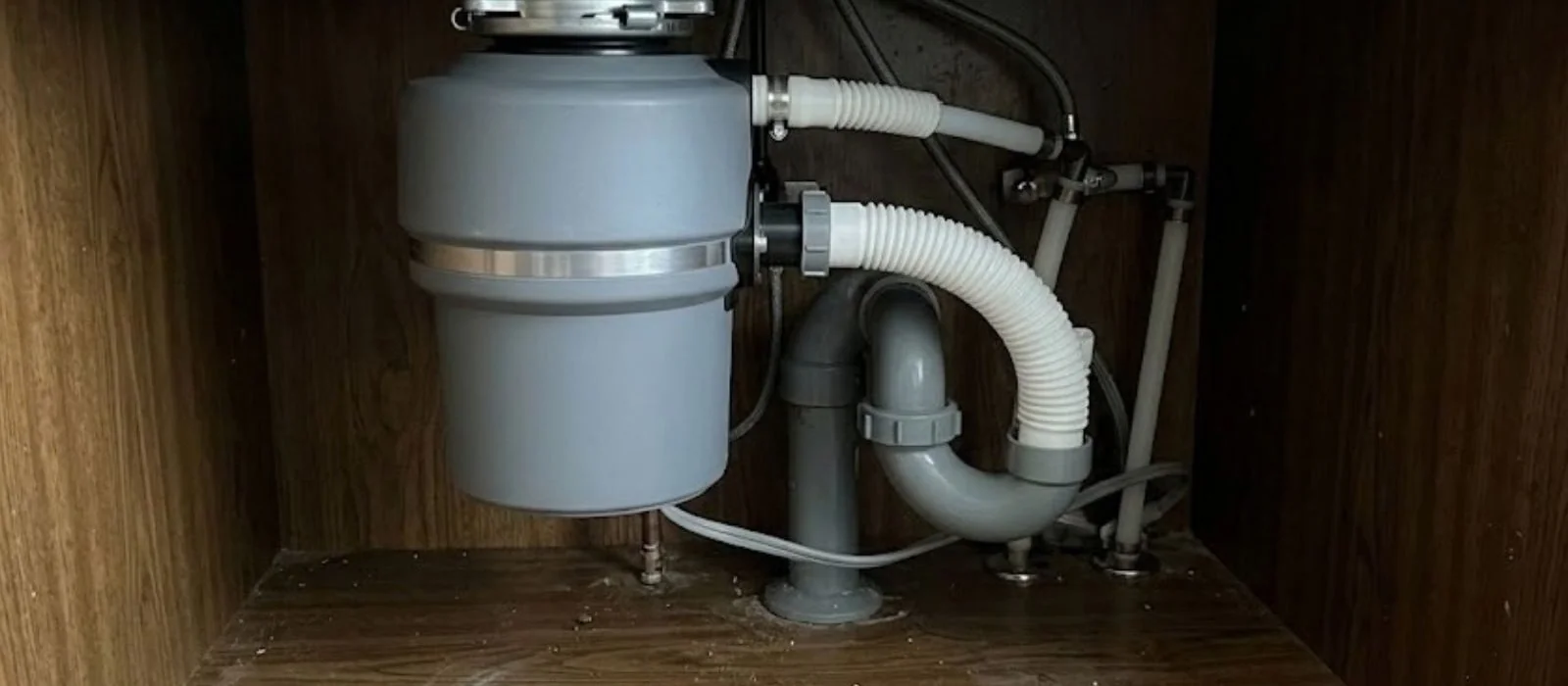
How a disposal fits a double sink
In a double sink, each basin has its own drain opening. The disposal replaces the strainer on one side, usually the basin with the larger bowl or the side nearer the dishwasher. The other basin sends its water through a tailpiece and a continuous waste tee into the disposal outlet.
From there everything leaves through a single trap and into the wall. The result is two sinks sharing one trap, which is why the pipe arrangement matters more than the disposal itself.
What you need to line up before you start
Before you buy or cut anything
A short survey of the cabinet avoids most wrong turns.
- Your model's owner manual, since the mounting system and hose fittings differ.
- Room under the sink for the disposal, a trap and the existing garbage can or storage.
- A dishwasher connection point. Check whether the dishwasher drains into the sink drain now.
- A switched outlet or a switch location for the disposal, and whether an outlet exists under the sink.
- The existing tailpiece, tee and trap condition. Corroded or cracked pieces should be replaced first.
- A plan for turning off the water to the sink and clearing the cabinet.
Drain and trap configuration: where installs go wrong
The usual double sink layout puts the disposal on one side, a tailpiece on the other and a tee between them leading to the trap. The disposal outlet points sideways into that tee. If the old pipes sit too low or too far apart, the geometry no longer works without new pieces.
The most common failure is a trap arrangement that holds water in the wrong place or creates a slow drain. A disposal also needs a clear route for its outlet to reach the tee. If adjustments mean cutting into the wall pipe, treat it as a plumbing installation job instead of a weekend fix.
The dishwasher knockout
Many disposals ship with a small plug on the dishwasher inlet. KitchenAid's installation guidance describes knocking the plug out with a hammer and screwdriver, driving it into the disposal, then pulling it out with needle-nose pliers. If you skip this step, the dishwasher cannot drain into the unit.
Retrieve the plug from inside the grinding chamber, because leaving it there can jam the unit. Attach the dishwasher drain hose to the inlet with the clamp supplied, and follow the dishwasher manual for the hose loop or air gap that keeps drain water from flowing back.
| Your situation | What the install involves | DIY or pro |
|---|---|---|
| Previous disposal being replaced | Swap the unit onto the same mount and outlet | Often DIY |
| First disposal, sink has a tee and trap | New unit, new tailpiece, tee check | DIY with care |
| Dishwasher drains elsewhere | Reroute the drain hose to the new inlet | Pro advised |
| No switch or outlet at the sink | New wiring or outlet | Licensed electrician |
| Pipes in wall are old or low | Drain alteration or rework | Licensed plumber |
Stuck at the drain pipes?
If the trap or tee will not line up, a plumber can finish the hookup. Same-day appointments are offered when available.
Electrical: where DIY ends
InSinkerator's installation page lists the electrical connection as step two, and offers cord or hardwire options on its EZ Connect models. A cord needs a switched outlet under the sink. A hardwired unit connects to a circuit, usually through a wall switch.
Water and electricity share a small cabinet, so this is where caution pays. If the sink has no outlet or switch, or if you are unsure the circuit can carry the load, have a licensed electrician do the wiring. A plumber handles the pipes and mounting around it.
A homeowner can usually handle
- Removing the old strainer and mounting the new unit per the manual.
- Knocking out the dishwasher plug and clamping the hose.
- Connecting the tailpiece and trap when the existing pipes line up.
- Running water and checking every joint for drips.
Call a licensed pro for
- Cutting or moving drain pipe, or rebuilding the trap.
- New wiring, a switch or a new outlet, which needs an electrician.
- Persistent leaks after a retry, or a sink that drains slowly after the install.
- Work a permit may cover. See the garbage disposal service for help.
Permits for a disposal install in Pennsauken
Pennsauken permits for plumbing work are handled by the township Construction Code Department at 2400 Merchantville Ave, (856) 665-1000, extension 1401, with a plumbing subcode official at extension 1406. Township Code Chapter 133 requires permits for construction except ordinary repairs, and plumbing permit fees are set in a schedule. Fees can change, so ask the department for the current schedule.
Whether a new disposal with new wiring needs a permit is a question for the department, not for this guide. Call before you start, and ask about both the plumbing and any electrical work. New Jersey allows plumbing work only by a master plumber, an authorized plumbing contractor or their employees. Ask any hired plumber for a license number and verify it with the State Board of Examiners of Master Plumbers.
Source type: Pennsauken Township Code Chapter 133 and Construction Code Department contacts, NJ Division of Consumer Affairs plumbing board
Test before you close the cabinet
Check the joints dry
Run a hand along every slip nut and flange, then dry them before water goes in.
Run water first
Fill both basins and let them drain with the disposal off. Watch the tee, trap and dishwasher connection for drips.
Power up with water running
Turn the disposal on with a steady stream of cold water. Listen for scraping or humming and shut it off at once if you hear either.
Run the dishwasher
Start a drain cycle and watch the hose joint. A leak here means a loose clamp or a missed knockout.
If you live near Maple Shade or Cherry Hill, the same layout and steps apply.
Standards and rules behind this advice
Manufacturer installation instructions set the order of drain, dishwasher knockout and mounting, and the National Electrical Code (NEC) covers the disposal circuit.
Disposal installation questions
Sometimes. If the sink already has a tee, tailpiece and trap that line up, a swap is simple. A first-time install usually needs at least a new tailpiece and a drain adjustment.
Measure the cabinet and compare it with your model's manual before buying.
The dishwasher drain hose connects to the inlet, but a sealed plug blocks the water. The dishwasher will back up or leave standing water in the tub.
Knock out the plug and remove it from the grinding chamber before first use.
Most are wired through a wall switch or plugged into a switched outlet under the sink. Some models offer either a cord or hardwire option.
If you have neither, an electrician should add one rather than rely on an extension cord.
Common causes are a low trap, a tee slope that holds water, or a partly blocked outlet. A tight bend in the drain can also hold solids.
Re-checking the pipe slope often fixes it. A persistent problem is a drain job, not a disposal fault.
Ask the township Construction Code Department at (856) 665-1000, extension 1401, before you start. Township Code requires permits for construction but makes an exception for ordinary repairs.
Whether your job counts is the department's call, and the answer may differ if you add wiring.