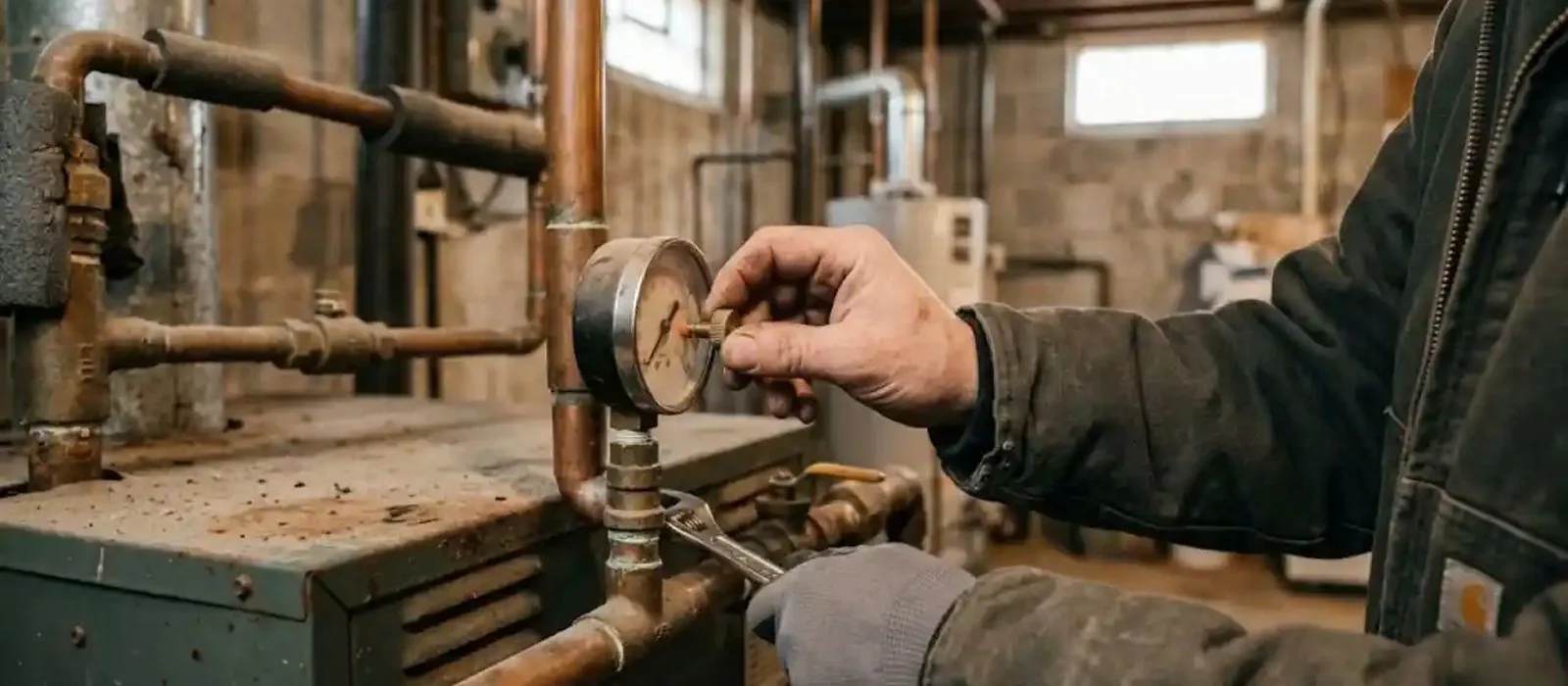
No heat: what to check before calling
Check the thermostat
Confirm it is set to heat, set above room temperature and has fresh batteries if it needs them.
Look at the boiler pressure gauge
Compare the reading with the range in your boiler manual. A reading near zero suggests a leak or low fill, and one that is far above range means call a plumber.
Check power and the switch
Many boilers have a service switch that looks like a light switch near the stairs. Make sure it is on and the breaker has not tripped.
Feel the radiators
If the boiler is hot but upper radiators stay cool, air may be trapped. If the boiler itself is cold, the problem is on the boiler side.
Stop and call if anything looks wrong
Water on the floor, a burning smell, soot or a boiler that keeps shutting off all need a licensed plumber.
Hot water or steam: why it matters
Older homes in Pennsauken may have either type, and the two behave differently. Check the boiler label and the radiators. A steam system has a sight glass and vents on each radiator, while a hot water system has a pressure gauge and an expansion tank. We also serve older heating systems in Maple Shade.
| Feature | Hot water system | Steam system |
|---|---|---|
| Heat carrier | Hot water pumped through pipes | Steam rising through pipes |
| Radiator valves | Bleeder valve at the top | Air vent that lets steam in |
| Typical gauge | Pressure and temperature | Low-pressure steam gauge and sight glass |
| Bleeding radiators | Yes, carefully | No, do not bleed steam radiators |
| Common noises | Gurgling, ticking, kettling | Banging from trapped water |
| Common failures | Circulator pump, air, expansion tank | Water level, vents, low-water cutoff |
Bleeding radiators the safe way
You can do
- Turn the thermostat down and let the system cool
- Place a cloth under the bleeder valve
- Open the valve a quarter turn with a radiator key until water spits steadily
- Close it and check the boiler pressure afterward
- Repeat on each upper radiator
Call a plumber when
- The boiler pressure keeps dropping after you add water
- Radiators stay cold with the pump running
- Water leaks from the bleeder or a pipe joint
- You have a steam system, which should not be bled
- The boiler shuts off by itself
Radiators cold and the boiler running?
Describe what you hear and what the gauge shows. We will tell you what is safe to try.
A leaking relief valve or wet floor
The pressure relief valve is a safety device. If it drips, pressure is too high, the expansion tank has failed or the valve itself is worn. Do not cap or plug it.
Turn off the boiler at its power switch, let it cool and call. If the water is hot or steaming, keep away. A leak at a pipe joint or the boiler jacket often means corrosion and needs inspection.
Banging, kettling and gurgling
Banging
Pipes pitched wrong or water trapped in a steam line often cause banging. Loose pipe straps can also knock.
Kettling
A rumbling like boiling in a kettle suggests scale or sludge on the heat exchanger. It needs a flush or cleaning, and ignoring it can shorten the boiler's life.
Gurgling
Air in hot water lines produces gurgling. Bleeding radiators may help, but constant air points to a leak or a failed air eliminator.
Clicking at start
Pipes expand as they heat. Light ticking is normal. Sharp cracks need a look.
Gas smell and carbon monoxide
A gas smell means leave right away. Skip the switches and phones inside, then call the gas utility or 911 from the yard or street.
Carbon monoxide has no odor. If a detector sounds, or anyone has headaches, nausea or dizziness, move everyone into fresh air and call 911. Each level of a home with a fuel-burning boiler should have a working CO detector.
Annual service, repair or replace
A yearly service by a licensed plumber checks combustion, venting, controls and water level before the heating season. It catches small faults when they are cheap. Older cast iron boilers can last a long time, but parts and efficiency eventually fall behind.
| Situation | Usual direction |
|---|---|
| Bad thermostat, pump or valve on a sound boiler | Repair |
| Cracked heat exchanger or leaking boiler body | Replace |
| Repeated failures in one season | Replace after a full inspection |
| Repair cost near the value of a new boiler | Replace |
| Frequent pressure loss with no visible leak | Inspect before deciding |
| Old unit with low efficiency and rising fuel use | Consider replacement |
Boilers in Pennsauken, NJ homes
The median home in the township dates to 1964, and the oldest housing is in the south. Homes of that era commonly have hydronic baseboard or radiator systems, and some older ones retain steam. Knowing which type you have changes the repair.
Water in the system comes from MPWC or NJ American Water, depending on your address. Check your bill, since fill water quality can affect scale in the boiler. For installs or fuel changes, see water heater installation.
Source type: US Census ACS data and township water provider public pages
What affects the price of boiler repair
Boiler work depends on the part, the system type and access. A diagnosis comes before a price.
Describe the problem on the 24/7 line and we triage by phone, then give a clear price before work starts.
Know the make and model
The boiler label lists them. A photo of it saves time.
Note the gauge
Write down the pressure and temperature before and after trouble.
Clear the space
Move storage away from the boiler so the plumber can reach it.
Record the symptoms
Note noises, smells and which rooms are cold.
Planning a boiler tune-up before winter?
Ask about annual service during the fall and avoid a cold-night breakdown.
Standards and rules behind this advice
Heating boilers are built to the ASME Boiler and Pressure Vessel Code, and gas piping follows NFPA 54, the National Fuel Gas Code. Carbon monoxide alarms are listed to the UL 2034 standard. According to the manufacturer's manual, relief valve and pressure settings are not for guessing.
What to do if you smell gas or suspect carbon monoxide
Treat both as a safety event first and a repair second.
- Leave the house with everyone and pets, and do not switch lights or appliances on or off.
- Call 911 or the gas utility from outside.
- Do not go back in until responders say it is safe.
- Call the 24/7 line afterward for the repair.
Boiler questions from older homes
Air in the lines, a failed circulator pump or a closed valve is the usual cause. Check that the thermostat is calling for heat and try bleeding upper radiators on a hot water system.
If that does not help, a plumber should test the circulator.
On a hot water system, yes, if the boiler is off and cool and you use a radiator key. Open the valve slightly until water spits steadily, then close it.
Never bleed steam radiators. They are vented differently.
The pressure may be too high, the expansion tank may have failed or the valve may be worn. Do not cap it.
Turn off the boiler and call. A leaking tank-type heater has a similar valve, covered under water heater repair.
For a gas smell, get out and call the gas utility or 911 from outside. For a CO alarm, move everyone into fresh air and call 911.
Stay out until responders say the home is clear.
Once a year, before the heating season, by a licensed plumber. The visit checks combustion, venting and controls.
Skipping service raises the odds of a mid-winter failure.
When the heat exchanger is cracked, failures keep repeating or repair cost approaches replacement. A plumber can inspect and explain the options.
We tell you plainly if repair no longer makes sense.
Yes. Steam systems have a water level, vents and a low-water cutoff that need specific care. Tell us what type you have when you call.
A leak that keeps feeding the system can also be traced with leak detection.